


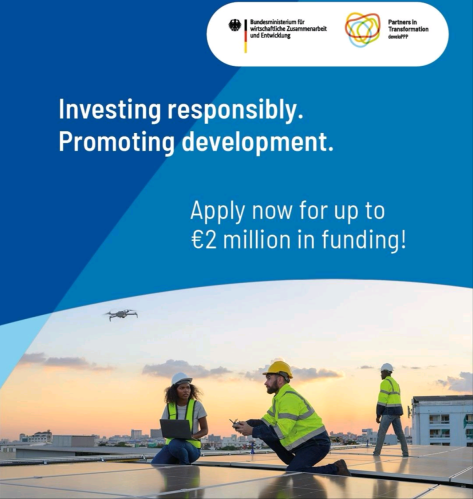
If you run an established company with a project that connects genuine business expansion to measurable development impact in a developing or emerging country, the develoPPP Classic Funding Programme 2026 is one of the most significant funding instruments currently open for applications. Backed by Germany’s Federal Ministry for Economic Cooperation and Development (BMZ) and implemented through two of the most experienced development finance organisations in the world, the programme funds projects between €100,000 and €2 million, covering up to 50% of total project costs. The current round deadline is September 30, 2026.
This is not a grant for ideas. It is structured funding for companies ready to execute a defined project that creates real, lasting value in a developing or emerging market while also advancing their own long-term business interests.
What develoPPP Classic Actually Is
develoPPP is a public-private partnership instrument run by the BMZ. The Classic track specifically is designed for established companies that want to invest or expand operations in one of more than 60 qualifying developing and emerging countries, provided that expansion also delivers a credible development benefit to the local economy or community.
The fundamental premise of the programme is simple: purely commercial projects do not qualify, and purely charitable ones do not either. What qualifies is a project where both objectives, business growth and development impact, are genuine, inseparable, and measurable. The BMZ co-finances that kind of project because it cannot achieve development outcomes on its own without private sector investment, and companies cannot always absorb the full cost and risk of operating in frontier markets without some public backing.
Selections are made through idea competitions held twice per year. This is the second round for 2026, with a deadline of September 30, 2026.
The Two Implementing Partners
Applications are submitted through one of two implementing partners, not directly to the BMZ. Choosing the right one for your project matters.
DEG Impulse gGmbH is a nonprofit subsidiary of DEG (Deutsche Investitions- und Entwicklungsgesellschaft), Germany’s development finance institution. DEG Impulse brings strong financial structuring expertise, deep experience working with private sector companies in complex markets, and a track record across energy, manufacturing, agribusiness, and financial services. If your project is finance-heavy, investment-focused, or involves significant capital infrastructure, DEG Impulse is likely the more natural fit.
Deutsche Gesellschaft für Internationale Zusammenarbeit (GIZ) GmbH is Germany’s primary technical cooperation agency, operating in more than 120 countries. GIZ brings implementation experience in skills development, agricultural systems, supply chain sustainability, and social standards. If your project involves training, value chain development, environmental standards, or community-level outcomes, GIZ is typically the stronger partner.
If you are unsure which fits your proposal better, the develoPPP website has contact persons who can help you decide before you apply.
What Kinds of Projects Qualify
The programme is sector-agnostic, which is one of its more useful features. Projects can span a wide range of activities and industries, as long as they combine a long-term business interest with a sustainable development benefit. Qualifying project types include:
Training and qualification of local skilled workers, building human capital that stays in the local economy long after the project ends.
Piloting innovative technologies or business models that are commercially promising but carry higher risk in a frontier market context than a company can absorb alone.
Sustainable supply chain development, including expanding environmentally responsible sourcing, introducing sustainability certifications, and supporting smallholder integration.
Improvement of environmental and social standards in production or manufacturing operations in the target country.
Sustainable agricultural systems and food security solutions that connect commercial agriculture with development outcomes for farming communities.
What the programme explicitly will not fund: purely commercial investments with no development dimension, purely charitable activities with no business rationale, and compliance measures required by law (such as Germany’s Supply Chain Due Diligence Act).
Funding Structure
The co-financing structure is important to understand before applying. The programme covers a maximum of 50% of total eligible project costs. The company must finance the remaining 50% or more from its own resources.
This means the minimum project budget for the smallest grant (€100,000 from BMZ) is €200,000 in total costs, with the company putting in at least €100,000 of its own money. For a project at the maximum funding level, the company is contributing at least €2 million alongside the €2 million from BMZ, making the total project size at least €4 million.
Applicants must demonstrate positive net income and sufficient equity and liquidity to carry their share of the costs. This is not a programme for companies that need the public funding to survive. It is for companies that are financially stable but want a strategic co-investor to share the risk of expanding into a developing market.
Who Can Apply: An Important Clarification
Most posts covering this programme have been vague about the headquartering requirement. The official develoPPP programme is primarily structured for companies headquartered in EU, EFTA, or OECD-DAC member countries. This means a German, British, French, Dutch, or similar company investing in Nigeria, Ghana, Kenya, or another qualifying African country is the core target applicant.
That said, African businesses can still engage with this programme in two legitimate ways. First, if your company has a parent entity, a registered subsidiary, or a formal partner company in an EU, EFTA, or OECD-DAC country, that entity can apply on behalf of a joint project and you can be the implementing partner on the ground. Second, if you are an African entrepreneur or business with dual registration or a holding structure in a qualifying country, the application route is open to you directly.
If you are a Nigerian or African company purely registered locally, the most practical approach is to reach out to the implementing partners directly. DEG Impulse and GIZ both have presence in Nigeria and across Africa, and they can advise on whether your project structure qualifies or how to structure a partnership that would.
Countries Where Projects Can Be Located
Projects must be implemented in one of develoPPP’s 60+ qualifying developing and emerging countries. Across Africa, this includes Nigeria, Ghana, Kenya, Ethiopia, Rwanda, South Africa, Senegal, Tanzania, Uganda, Côte d’Ivoire, and many others. The full country list is available on the develoPPP website.
How to Apply
Applications for the develoPPP Classic Funding Programme 2026 are submitted through the official online application platform. You register on the platform, choose your implementing partner (DEG Impulse or GIZ), and submit your project proposal there.
Application Platform: https://oap.developpp.de/
Official Programme Page: https://www.developpp.de/en/application/classic/
Deadline: September 30, 2026
If you are unsure whether your project qualifies or which implementing partner is the right fit, contact the develoPPP team directly through the contact page on the official website before submitting. Both DEG Impulse and GIZ have regional advisors who can review your project concept informally before you invest time in a full application.
The develoPPP Classic Funding Programme 2026 is a serious instrument for serious projects. The funding is real, the implementing partners are experienced, and the development finance ecosystem it connects you to extends well beyond the grant itself. If your company is ready to expand into a developing market and you can make a credible case for both the business case and the development case, September 30 is the date to work toward.
For more verified opportunities like this, updated monthly, visit: https://utibeetim.com/list-of-latest-opportunities-for-the-month/
Thank you for reading this post, don't forget to subscribe!
Are you interested in receiving the latest grant, funding, and business opportunities?
Join our newsletter for free and stay updated!
Click here to join our newsletter
Join our community:
Join our WhatsApp group
Join our Telegram group
Join our Facebook group