


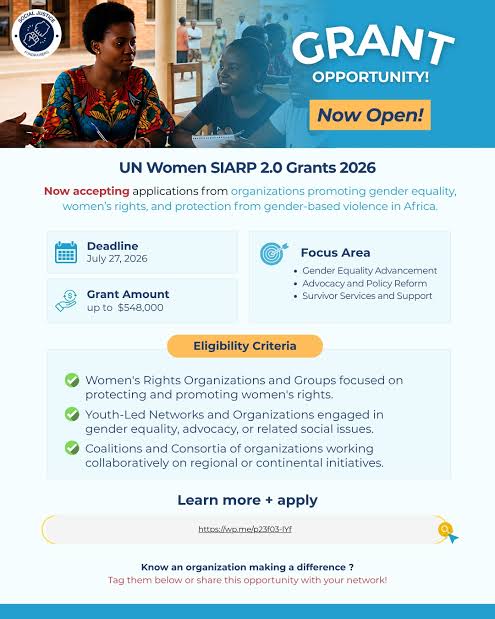
UN Women has opened a major call for proposals under the Spotlight Initiative Africa Regional Programme 2.0, known as SIARP 2.0, offering multi-year grants of between USD 110,000 and USD 548,000 to civil society organisations working to end violence against women and girls across Africa. For Nigerian NGOs, women’s rights groups and youth-led organisations already active in gender equality work, this is one of the largest and most structured funding opportunities to emerge this year, and the clock is ticking toward a 27 July 2026 deadline.
What Is the Spotlight Initiative Africa Regional Programme 2.0?
The Spotlight Initiative is a partnership between the European Union and the United Nations, first launched globally in 2017 to eliminate violence against women and girls as a standalone, “spotlighted” priority rather than a side issue folded into broader development work. In Africa, the programme is jointly driven by the African Union Commission, the European Union and four UN agencies: UN Women, UNFPA, UNICEF and UNDP.
The first phase of the programme, SIARP 1.0, is credited with helping push through the first-ever African Union Convention on Ending Violence Against Women and Girls, a landmark continental legal instrument. Building on that momentum, SIARP 2.0 was formally launched on 14 February 2026 in Addis Ababa during the 39th African Union Assembly, under the theme “Accelerating Africa’s Promise: Uniting Action to End Violence Against Women and Girls.” It is described as a scaled-up, multi-sectoral partnership with renewed funding and a sharper focus on turning policy commitments into action on the ground.
The programme works through four connected pillars: strengthening legal and policy frameworks backed by real data, investing in prevention efforts that shift harmful social norms, expanding survivor-centred services, and backing the women’s rights and youth-led movements that keep governments accountable. This current call for proposals is specifically about resourcing civil society to deliver on the third and fourth pillars.
Why This Matters for Nigerian CSOs and NGOs
Nigeria remains one of the countries where gender-based violence, child marriage and restricted access to sexual and reproductive health services are persistent, well-documented challenges. Yet many capable Nigerian organisations doing frontline work in these areas are chronically underfunded, often surviving on small, short-term grants that make it difficult to plan multi-year interventions or build lasting institutional capacity.
SIARP 2.0 is different in scale and structure. A 27-month funding window and grants running into the hundreds of thousands of dollars give organisations room to design interventions that actually change outcomes rather than just deliver a single workshop or campaign. For established Nigerian NGOs, this call is also an opportunity to formalise partnerships with regional networks and consortiums, which strengthens their profile for future UN and EU-funded programmes.
Full Eligibility Criteria
According to UN Women’s call for proposals, applicants must meet the following criteria:
- Be a registered civil society organisation, women’s rights organisation, youth-led organisation, non-governmental organisation, or a regional/national network or consortium.
- Operate at continental, regional, sub-regional or multi-country level across Africa, with demonstrated presence or partnerships in the target countries of implementation.
- Have a documented track record of work related to gender-based violence, harmful practices, sexual and reproductive health and rights, or women’s and youth movement building.
- Demonstrate institutional and financial management capacity to absorb and account for grants of this size over a 27-month period.
- Be able to work in partnership with other civil society actors, government stakeholders and UN entities where relevant.
- Applications may come from single organisations or consortiums; consortium applications should clearly identify a lead applicant.
Nigerian organisations applying independently or as part of a West and Central Africa consortium are both eligible, provided the proposal aligns with the programme’s thematic priorities.
What SIARP 2.0 Grants Cover
- Grant sizes ranging from USD 110,000 to USD 548,000 per project, depending on scope and geographic coverage.
- A 27-month implementation period running from October 2026 to December 2028, allowing for genuine multi-year programme design.
- Funding directed toward interventions in ending violence against women and girls, eliminating harmful practices such as child marriage, advancing sexual and reproductive health and rights, and strengthening survivor-centred services.
- Support for policy accountability and social norms transformation work, not just direct service delivery.
- Backing for women’s rights and youth-led movement building, including coalition and network strengthening.
- Association with a globally recognised UN Women and EU-backed programme, which can open doors to further funding and partnerships.
How to Apply for SIARP 2.0
Applications are submitted directly through UN Women’s official call for proposals page rather than a general online portal, so organisations need to follow the specific instructions carefully. Here is the step-by-step process:
- Step 1: Visit the official UN Women SIARP 2.0 call for proposals page and download the full call document and application template, available in English and French.
- Step 2: Review the thematic priority areas closely and decide which pillar your organisation’s proposed project fits best: legal accountability, prevention and norms change, survivor services, or movement building.
- Step 3: Confirm your organisation’s eligibility, including registration status, geographic scope of operation, and prior track record in the relevant thematic area.
- Step 4: Complete the Call for Proposals template in full, ensuring your budget, results framework and implementation timeline align with the 27-month project window.
- Step 5: If applying as a consortium, clearly designate the lead applicant and outline each partner’s role and responsibilities.
- Step 6: Submit the completed application through the channel specified in the call document before the deadline, and direct any clarification questions to the contact listed on the official page.
Deadline: Time Is Running Short
The application window closes on 27 July 2026. As of today, that leaves a narrow runway for organisations that have not yet started preparing their submissions. Given the depth of documentation required, budget templates, results frameworks and partnership letters among them, interested organisations should treat this as an urgent priority rather than something to revisit next week.
Final Thoughts
SIARP 2.0 represents one of the more meaningful funding windows for gender equality work in Africa this year, both in the size of individual grants and in the credibility that comes with UN Women, the African Union and the European Union backing the programme. Nigerian civil society organisations working on gender-based violence, harmful practices or reproductive health and rights should not let the 27 July 2026 deadline pass without at least reviewing their eligibility.
Start preparing your documentation today, review the official call carefully, and reach out to the contact listed on the UN Women Africa page if you need clarification before submitting. You can also read more about the origins and scope of the wider programme on the official Spotlight Initiative website.
You Might Also Like
Nigerian organisations exploring adjacent funding streams may also want to check out the French Embassy Fund for Nigerian Civil Society Organizations, the ACT Trust Foundation Grant Program for NGOs, and the SparkUp Initiative Fellowship for Women-led Organizations.
Thank you for reading this post, don't forget to subscribe!
Are you interested in receiving the latest grant, funding, and business opportunities?
Join our newsletter for free and stay updated!
Click here to join our newsletter
Join our community:
Join our WhatsApp group
Join our Telegram group
Join our Facebook group