
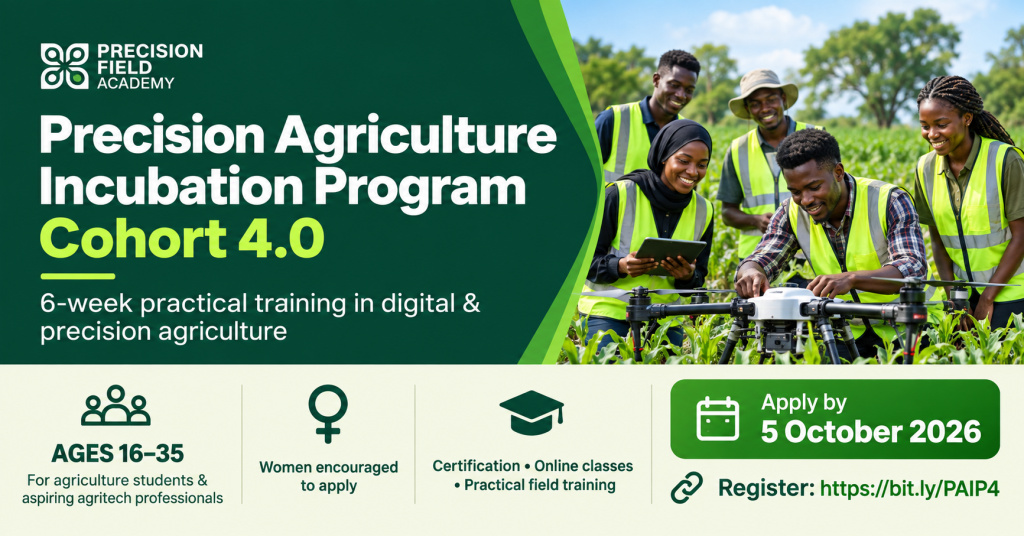
Nigeria’s farms still run mostly on guesswork. A farmer plants by instinct, sprays by habit, and only finds out a section of the field failed after the harvest is already short. Precision agriculture closes that gap, and a new cohort of a global training programme just opened its doors to young Nigerians who want to learn how.
Applications are open for Cohort 4.0 of the Precision Agriculture Incubation Program (PAIP), a six week hands on programme built around drones, GIS mapping, remote sensing, and digital agriculture tools. It is organised by Precision Field Academy, and unlike a lot of programmes that quietly exclude Nigerians once you read the fine print, this one is open to applicants both within and outside Africa.
This is not another theory heavy webinar series. Participants fly agricultural drones, read satellite imagery, map crop health, and learn how to package all of it into a service they can sell to real farmers. For any young Nigerian trying to move from informal agribusiness into a structured AgriTech venture, this is one of the more practical entry points open right now.
About the Programme
PAIP is run by Precision Field Academy, an African AgriTech education and skills development organisation focused on preparing young people for careers in digital and precision agriculture. Cohort 4.0 is the fourth funding and training cycle under this initiative.
The programme blends virtual learning with practical, field based sessions. It covers the technologies that are quietly reshaping modern farming everywhere else in the world: agricultural drones, geographic information systems, remote sensing, satellite and multispectral imagery, and data driven crop monitoring.
What sets it apart from a typical short course is the entrepreneurship layer. Beyond the technical training, participants are walked through how to build an actual AgriTech business around these skills, including Drone as a Service models, client farm assessments, and pricing.
Benefits
Participants who complete the programme walk away with more than a certificate to hang on a wall. Here is what is actually on offer:
- Hands on training in agricultural drone operations, including pre flight checks and flight safety
- Practical exposure to GIS mapping, remote sensing, and multispectral crop sensing
- Training in crop health monitoring and prescription mapping using real data
- A structured introduction to AgriTech enterprise development, including Drone as a Service business models
- Precision Field Academy PAIP Fellow certification, which the academy describes as globally accredited
- Merit based scholarships, with partial and full tuition funding available to selected participants
That certification matters more than it sounds. Agricultural technology is one of the few areas in Nigeria right now where demand for skilled hands, people who can actually fly a drone and interpret the data it collects, is growing faster than supply.
Eligibility Criteria
PAIP Cohort 4.0 is open globally, and applicants do not need to be based in Africa to qualify. To apply, you should fall into one of these categories:
- Be between 16 and 35 years old
- Be an agriculture student, university graduate, or young farmer
- Be an agripreneur, agronomist, or agriculture professional
- Be a researcher, academic, or early career technology professional interested in AgriTech
- Have a genuine interest in precision agriculture, even without prior technical experience
Women are particularly encouraged to apply. There is no requirement to already own a farm or run an existing agribusiness, which makes this accessible to students and career changers as much as established agripreneurs.
Documents Needed to Apply
The application itself is a form, not a stack of documents, but you should have these ready before you start:
- Basic educational or professional background information
- A short description of your experience in agriculture or digital technology, if any
- A clear statement of the agricultural problem you would like to address
- Your reasons for wanting to join the programme and the skills you hope to develop
- A plan for how you intend to apply the knowledge after the programme ends
That last point is where most applicants lose marks without realising it. Reviewers are not just checking whether you can operate a drone, they want to see that you have thought about what happens after the six weeks, whether that is starting a Drone as a Service outfit or improving an existing farm operation.
If your goal is to turn what you learn in PAIP into a registered AgriTech business rather than just a certificate, it helps to already have a solid business plan in place before you apply, so you know exactly how the skills fit into a real venture. We have a business plan service that can help you put that structure together.
Key Details at a Glance
Programme: Precision Agriculture Incubation Program (PAIP) Cohort 4.0
Organizer: Precision Field Academy
Eligible location: Global, open to applicants in and outside Africa, including Nigeria
Funding available: Partial and full merit scholarships available, with a commitment fee of ₦5,000 or US$5 for selected participants
Application deadline: October 5, 2026
How to Apply
- Visit the official PAIP Cohort 4.0 application form online.
- Fill in your educational or professional background and your experience with agriculture or digital technology.
- Describe the agricultural problem you want to work on and why the programme interests you.
- Explain how you plan to apply what you learn once the six weeks are over.
- Submit the form before the October 5, 2026 deadline. No specific closing time has been stated, so do not wait until the last day.
You can apply directly through the official PAIP Cohort 4.0 application form.
Final Thoughts
Precision agriculture is not a foreign concept anymore. Large Nigerian farms are already using drones for spraying and satellite data for yield forecasting, and the people who understand that technology are the ones who will run those operations in a few years.
PAIP Cohort 4.0 gives you a structured way into that space without needing to already own expensive equipment. Whether you finish the programme and go work for an existing farm or start your own Drone as a Service business, the certification and the skills carry weight.
For more grants, accelerators, and funding opportunities like this one, keep an eye on our list of latest opportunities for the month. And if you are ready to turn any of these opportunities into a real registered business, our business registration service can help you get set up with CAC the right way.