
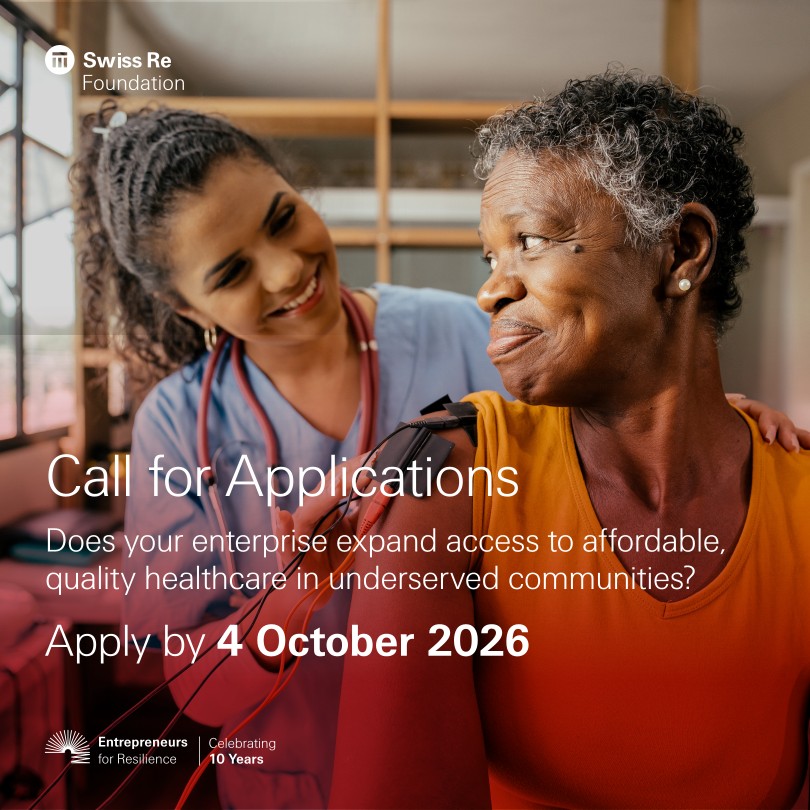
The Entrepreneurs for Resilience 2027 is the tenth edition of one of the most credible and consistently well-funded social enterprise programmes in the global healthcare space, and applications are open right now until October 4, 2026 at 23:59 CET. Run by the Swiss Re Foundation in partnership with the Digital Connected Care Coalition, AXA EssentiALL, Sanofi’s Global Health Unit’s Impact Fund, and the Philips Foundation, the programme selects between three and four social enterprises operating healthcare access models in low- and middle-income countries and supports them with a combination of funding, structured technical assistance, corporate expertise, and long-term network access.
The funding available is significant. Selected candidates share USD $360,000 in grants during the due diligence phase, followed by up to USD $1 million in blended financing distributed over two years among the top finalists. For a social enterprise at the right stage, this is not just capital. It is two years of serious institutional backing from a Swiss reinsurer with a global network and a decade of credibility in this space.
What the Tenth Edition Is Looking For
The Entrepreneurs for Resilience 2027 continues the focus that the programme established in recent editions: scaling access to affordable, quality primary healthcare for underserved populations in low- and middle-income countries through what the Swiss Re Foundation calls the brick-and-click model.
The brick-and-click concept is specific and worth understanding precisely before applying. Brick refers to a physical point of care, either fixed or mobile, staffed by a health worker. This is the human element. The presence of a trained person who can establish trust, conduct examinations, and provide direct clinical interaction with the patient. Click refers to a digital tool that supports and extends that physical delivery. This could be a diagnostic application, a patient records system, a telemedicine layer, a community health worker platform, a pharmacy management system, or any digital intervention that increases the reach, quality, or efficiency of the physical care being delivered.
The two elements must work together. A purely digital health product with no physical component is not the model the programme is seeking. A purely physical clinic with no meaningful digital component is also not the target. The enterprises that have won in previous editions, including SwipeRx, PillTech, M-Swasth, Clínica del Azúcar, and CarePay, all combined a strong on-the-ground presence with digital tools that made their model scalable without proportionally scaling cost.
What Selected Enterprises Receive
The programme operates in two rounds of support, each with a different level of intensity and funding.
In the first round, six to eight candidates are selected from the full applicant pool. Each receives an equal share of USD $360,000 in grants, meaning roughly $45,000 to $60,000 per organisation depending on the number selected. Alongside the funding, each of these candidates receives three days of technical assistance in impact measurement and financial management from specialist consultants during the due diligence phase. This first round runs over approximately five months.
In the second round, three to four finalists are selected from the first-round group. These finalists share up to USD $1 million in blended funding, combining conditional and unconditional financing, distributed in instalments over a two-year implementation period. Importantly, the programme is explicit that the top-ranked finalist can receive up to USD $350,000 individually. In addition to the funding, finalists receive up to 20 days of structured technical assistance over the two years, access to domain expertise from Swiss Re and DCCC partner organisations including specialists in healthcare service provision, digital integration, patient financing, and microinsurance.
Beyond funding and technical support, finalists are connected to a peer network of healthcare entrepreneurs from previous programme cohorts, and gain visibility within the global healthcare and impact investment communities. The People’s Choice Award winner, selected through a public online vote, is also invited to a Sankalp Forum event to connect directly with potential investors.
Follow-on funding from the Philips Foundation or the Sanofi Impact Fund is also a potential outcome for the strongest performers, though not a guaranteed component of the programme.
Eligibility
The eligibility criteria for the Entrepreneurs for Resilience 2027 are more demanding than a standard grant competition. The programme is designed for social enterprises that are already operating at meaningful scale, not for startups in the early stages of product development.
Your social enterprise must demonstrate significant, measurable social impact. At least 30% of your customer or beneficiary base must be low-income populations as your primary target, not an add-on to a commercial offering. You must operate in one or more low- and middle-income countries as defined by the World Bank. Nigeria, Ghana, Kenya, Tanzania, Rwanda, Ethiopia, Uganda, Senegal, and most of sub-Saharan Africa qualify.
You must operate on a market-based revenue model that is already generating earned revenue and can demonstrate credible growth potential. The programme is not for enterprises that rely entirely or primarily on donations or grant funding with no commercial revenue stream.
On size, your organisation must have been established by 2023, currently serve at least 50,000 people, and have a credible pathway to reaching 100,000 people within two years of receiving support. Both of these thresholds are meaningful. If you are not yet serving 50,000 people, this edition is not the right fit.
Both for-profit and not-for-profit organisations can apply, provided they meet the revenue model criteria. You must also be able to receive funding from a Swiss non-governmental organisation, which requires compliance with your country’s legal framework around international funding receipts.
A full eligibility booklet covering the specific criteria and application guidance is available directly from the Swiss Re Foundation:
Eligibility and Application Guide (PDF): https://www.swissrefoundation.org/dam/jcr:f1a6789c-e733-4684-a753-5620f8be2004/2026-08-srf-booklet-e4r27-final.e564761b326cc3587af05609ed5ef225.pdf
Read it in full before you start the application. The criteria have nuances that the summary points do not fully capture, and understanding them in detail will make the difference between a strong application and a misfired one.
How to Apply
Applications are submitted through the official Swiss Re Foundation application portal. The portal is open from September 7 through October 4, 2026, and only applications submitted in English before the deadline will be considered.
Application Link: https://application.swissrefoundation.org/en
Programme Page: https://www.swissrefoundation.org/e4r27.html
Deadline: October 4, 2026 at 23:59 CET
The Entrepreneurs for Resilience 2027 is entering its tenth year, and the programme’s track record of backing social enterprises that go on to serve hundreds of thousands of people across Africa, Asia, and Latin America is one of the strongest in global health impact investing. If your social enterprise is already operating a hybrid healthcare model at meaningful scale in a low-income country, applying before October 4 is time well spent.
For more verified opportunities like this, updated monthly, visit: https://utibeetim.com/list-of-latest-opportunities-for-the-month/