
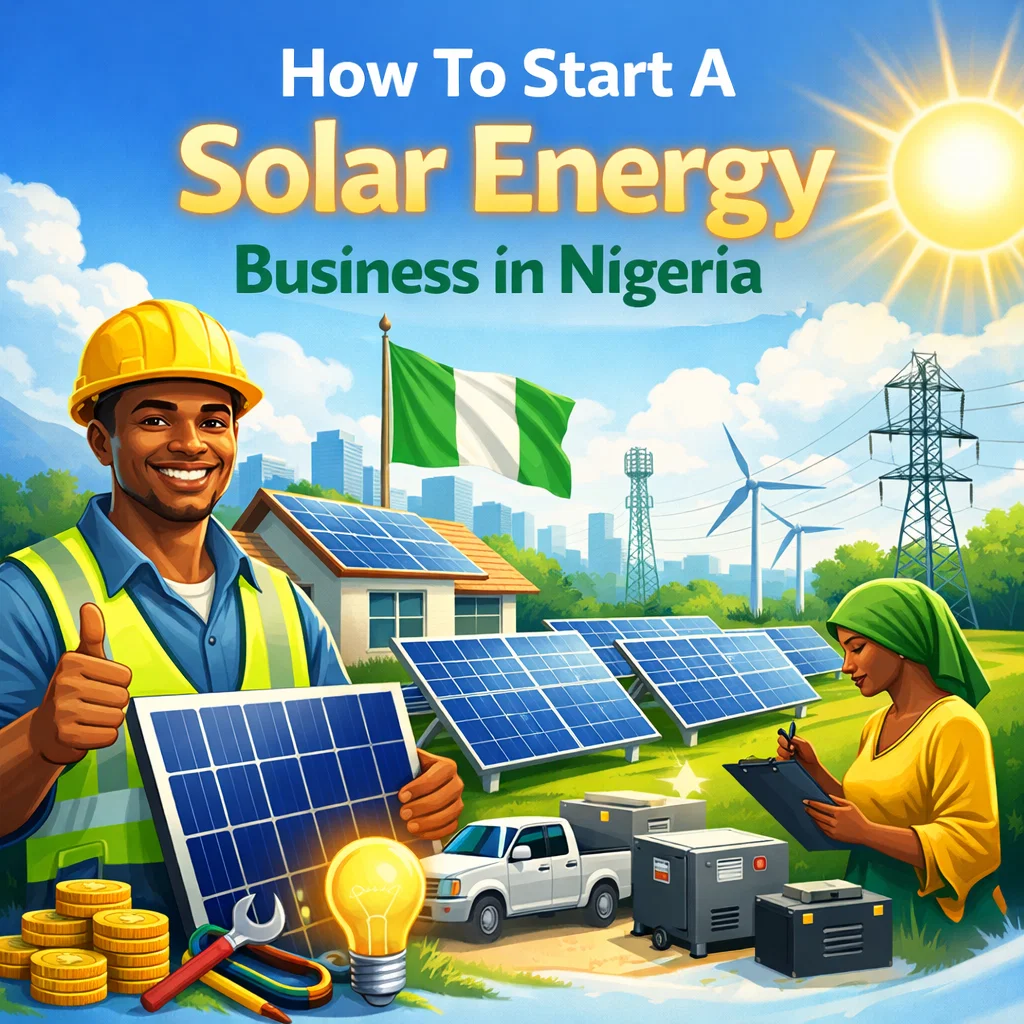
Nigeria’s energy sector is undergoing a transformation, and at the heart of this change is solar energy. With over 86 million Nigerians lacking access to reliable electricity and businesses spending an estimated $14 billion annually on diesel generators, the demand for alternative energy solutions has never been more urgent. 2026 presents a perfect opportunity for solar energy enthusiast who want to setup a solar energy business in Nigeria
And this is because the market isn’t just growing, it’s exploding. In 2025 alone, Nigeria emerged as Africa’s second-largest solar market, installing 803 MW of new capacity, representing a staggering 141% year-on-year growth. The country’s cumulative solar capacity surged from approximately 385 MW in 2024 to nearly 1.19 GW in 2025, with off-grid installations accounting for roughly 96% of total installed capacity.
In this comprehensive guide we will walk you through everything you need to know in order to establish and scale your own profitable solar energy business in Nigeria’s booming renewable energy sector.
What is Solar Energy and How It Works
Solar energy is about converting sunlight into electricity using photovoltaic (PV) panels or solar thermal systems . It’s a clean, renewable process that involves a few key components working together:
Solar Panels (Photovoltaic Modules): These are the most visible part. They are made up of photovoltaic (PV) cells, usually from silicon, which absorb sunlight and convert it into direct current (DC) electricity. There are two main types you’ll encounter in the market:
- Polycrystalline: Slightly lower efficiency, bluish hue, and typically more affordable
- Monocrystalline: Higher efficiency, sleeker black look, but generally more expensive.
Inverter: The DC electricity produced by panels cannot be used directly by most home appliances, which run on alternating current (AC). The inverter is the “brain” of the system, converting DC into usable AC power.
Battery Bank: This is crucial for a country like Nigeria. Since the sun doesn’t shine at night, batteries store excess electricity generated during the day for use when the sun is down or during cloudy periods. The cost and technology of batteries (like Lithium-ion and deep-cycle lead-acid) are key factors in system pricing.
Charge Controller: This device sits between the panels and the battery, regulating the voltage and current to prevent overcharging and ensure the battery’s longevity.
Why Start a Solar Energy Business in Nigeria?
The Nigerian solar energy sector presents compelling opportunities backed by solid economic fundamentals, supportive policies, and urgent market demand. Let me break down the key drivers:
1. Massive Electricity Access Gap
Nigeria faces one of the world’s largest electricity deficits. Current statistics reveal:
Grid reliability: The national grid produces only about 4-5 GW against a forecasted peak demand of 20 GW, despite an installed capacity of 13 GW
86 million people (approximately 40% of the 230 million population) lack access to electricity
Rural electrification rate: Only 30% of rural communities have access to reliable electricity
Urban challenges: Even in cities like Lagos, the access rate hovers around 85-89%, with frequent power outages affecting daily operations
2. Explosive Market Growth
The numbers tell a powerful story of exponential growth:
- Nigeria’s renewable energy market is projected to grow from 3.59 GW in 2025 to 14.07 GW by 2031, representing a compound annual growth rate (CAGR) of 25.58%
- Solar panel imports reached N242.68 billion in the first half of 2025 alone, up 17.29% from the same period in 2024
- Nigeria imported over 1,721 megawatts of solar solutions in H1 2025, making it the second-largest importer of solar energy solutions in Africa
- The country added 803 MW of new solar capacity in 2025, representing 141% year-on-year growth
3. Strong Economic Rationale
The economics heavily favor solar adoption:
- Cost competitiveness: Solar energy costs between N85-N150 per kWh compared to grid rates of N220-N270 per kWh
- Diesel alternative: With fuel subsidies removed and diesel prices skyrocketing 500% post-subsidy removal, solar provides significant cost savings over diesel generators
- Business opportunity: The market demand for off-grid solutions including mini-grids and solar home systems is estimated at $9.2 billion per year
- Long-term savings: Commercial and industrial customers achieve 20-30% savings versus diesel self-generation, with some projects reporting up to 44% energy cost reductions
4. Supportive Government Policies
The regulatory environment has improved significantly:
- Electricity Act 2023: Decentralized market oversight, allowing states to define feed-in tariffs
- Feed-in Tariff Regulation 2015: Provides framework for renewable energy power purchase
- Seven-year tax holidays: Significantly improving project economics for renewable energy ventures
- Import duty exemptions: Solar panels are exempt from import duties
- Mini-Grid Regulation 2016: Created framework for mini-grid development with over 100 operational systems
5. Access to Funding
Local currency financing: Recent $80 million Naira-denominated facility from Sun King, IFC, and Stanbic IBTC Bank demonstrates growing local currency debt options
World Bank’s DARES program: $750 million project to provide electricity access to 17.5 million Nigerians through distributed renewable energy
Blended finance structures: Combining grants, concessional loans, and private equity
Results-Based Financing (RBF): Programs like the Nigeria Electrification Project provide grants linked to verified connections
International investment: Major funding from development finance institutions, including IFC, AfDB, and private investors like Breakthrough Energy Ventures
6. Proven Success Stories
Nigerian solar companies are thriving and attracting significant investment:
- Arnergy: Raised $18 million in Series B funding (April 2025), with over 1,800 installations across 35 states
- Sun King: Secured $80 million facility to scale off-grid solar access
- EM-ONE: Delivered over 320 project sites with 20 MW solar installed and 90 MWh in battery storage
- Starsight Energy: Serving hundreds of industrial, educational, healthcare, and retail clients
Solar Energy Business Models You Should Know
Understanding the various business models in the Nigerian solar sector is crucial for positioning your venture. Each model addresses different market segments and requires different capital structures, expertise, and go-to-market strategies.
1. Pay-As-You-Go (PAYG) Solar Home Systems
Customers purchase solar systems through affordable daily, weekly, or monthly installments via mobile money or cash, eliminating prohibitive upfront costs.
How it Works:
- Initial small deposit (sometimes zero down payment)
- Daily payments as low as N200 ($0.14-$0.21)
- Repayment period typically 12-24 months
- Smart meters enable remote monitoring and payment verification
- System locks if payments lapse but unlocks upon payment
Target Market:
- Low-to-middle income households
- Rural and peri-urban communities
- Small retail businesses
- Urban poor with irregular income
Revenue Model:
- Interest on installment payments
- Value-added services (insurance, upgrades)
- After-sales maintenance contracts
Capital Requirements: Moderate to High (requires working capital to finance customer loans)
2. Mini-Grid and Microgrid Solutions
Deploying standalone or interconnected solar mini-grids (typically up to 10 MW) to power entire communities, commercial clusters, or underserved grid-connected areas.
How It Works:
- Solar panels + battery storage + backup generators (hybrid systems)
- Distribution network to multiple customers
- Can be standalone (off-grid) or interconnected with national grid
- Smart metering and billing systems
- Long-term contracts (10-20 years)
Target Market:
- Rural communities without grid access
- Industrial/commercial clusters
- Urban areas with unreliable grid supply
- Government/institutional facilities
- Agricultural processing centers
Revenue Model:
- Monthly electricity tariffs
- Connection fees
- Maintenance contracts
- Government subsidies/grants
- Carbon credit revenues
Capital Requirements: High (infrastructure-intensive)
3. Commercial & Industrial (C&I) Solutions
Designing and installing customized solar systems for businesses, factories, hospitals, schools, and other commercial entities seeking to reduce energy costs and ensure reliability.
Example Projects:
- 1.52 MW Solar Microgrid for Abuja government buildings
- 4 MW project at major brewery
- 950 kWp rooftop for Big Bottling Company
Examples: Starsight Energy, EM-ONE, Arnergy, GreenPower Technologies
4. Solar Product Distribution and Retail
Importing, distributing, and retailing of solar products (panels, inverters, batteries, charge controllers, accessories) and here is how it works:
YouImport directly from manufacturers in (China, UAE, India),
Engage in wholesale to installers and dealers
Including retail sales through physical stores or e-commerce.
You will also offer technical support and warranty services.
5. Solar Installation and EPC Services
Providing professional installation, engineering, procurement, and construction services for solar projects of various scales. Factors that will be responsible for your business success include:
- Working with Certified engineers and technicians
- Prooviding Quality service and reputation
- Complying with Safety standards
- Competitive pricing
- And excellent Customer service
Target Market: Homeowners, SMEs, Large corporations, Government agencies, NGOs and development organizations.
Revenue Model (How you make money): Installation fees, Maintenance contracts (annual), System upgrades and expansions, Training and capacity building.
6. Energy-as-a-Service (EaaS) Model
Zero upfront cost model where the solar provider installs, owns, operates, and maintains the system while the customer pays for energy consumed.
Starting a Solar Energy Business: Step-by-Step Guide
Based on extensive consulting experience and current market realities, here’s a comprehensive roadmap to launching your solar energy business in Nigeria.
Step 1: Market Research and Business Model
Understand your target market, competition, and develop a viable business strategy, you will need to know the demand patterns in your target region. Look at residential needs, commercial prospects, and potential partnerships with agencies driving rural electrification.
Decide whether you will focus on distribution, installation services, large projects, or hybrid models. Smaller retail operations require less capital but offer lower margins, while project sales command higher returns but demand greater investment.
Step 2: CAC Registration & Tax Compliance
- Corporate Affairs Commission (CAC): The first legal step is to register your business name or incorporate a limited liability company with the CAC. This gives your business legal standing.
- Federal Inland Revenue Service (FIRS): Upon registration, obtain your Tax Identification Number (TIN) for corporate tax filings and VAT registration.
Step 3: Get a Solid Business Plan & Funding
- Write a detailed business plan covering your market analysis, chosen business model, marketing strategy, operational plan, and financial projections. This is essential for attracting investors or securing loans.
- Explore various financing avenues: personal savings, bank loans, venture capital, and sector-specific grants and funds mentioned earlier.
Recommended for you: Solar Business Plan with 3 years financial projections
Step 4: Licensing and Regulatory Compliance
- Nigerian Electricity Regulatory Commission (NERC): Depending on your business model, you may need a license. Simple rooftop installations often require less stringent permitting, but generating power for distribution (like a mini-grid) requires specific generation and distribution licenses from NERC. Always consult their latest regulations.
- Standards Organisation of Nigeria (SON): To ensure quality and build trust, all imported and locally manufactured solar products (panels, batteries, inverters) must meet SON’s standards. Familiarize yourself with these requirements to avoid importing substandard goods that could be seized or damage your reputation.
Step 5: Sourcing Products & Reliable Suppliers
- Establish relationships with reputable manufacturers or tier-one distributors for your components. While price is important, prioritize quality and warranties. A failed battery or inverter can destroy your brand’s reputation instantly. Be mindful of import duties and exchange rate volatility when planning your procurement.
Marketing and Customer Acquisition
- Your marketing message should focus on solving the customer’s pain points: elimination of generator noise and fumes, significant long-term cost savings on fuel and maintenance, and the peace of mind that comes with 24/7 power. Use a mix of digital marketing, partnerships with real estate developers, and direct sales to target residential and commercial clients.
- After sales support: Offer warranties and maintenance plans. Reliable support builds customer confidence and repeat business.
Conclusion
Starting a solar energy business in Nigeria isn’t just entrepreneurial—it’s strategic. With explosive growth, supportive policies, and undeniable economics, the sector offers substantial returns while solving a national crisis. Success demands quality focus, compliance, and customer-centric approaches. If executed well, your venture can thrive amid Africa’s solar boom.
Thank you for reading this post, don't forget to subscribe!
Are you interested in receiving the latest grant, funding, and business opportunities?
Join our newsletter for free and stay updated!
Click here to join our newsletter
Join our community:
Join our WhatsApp group
Join our Telegram group
Join our Facebook group