
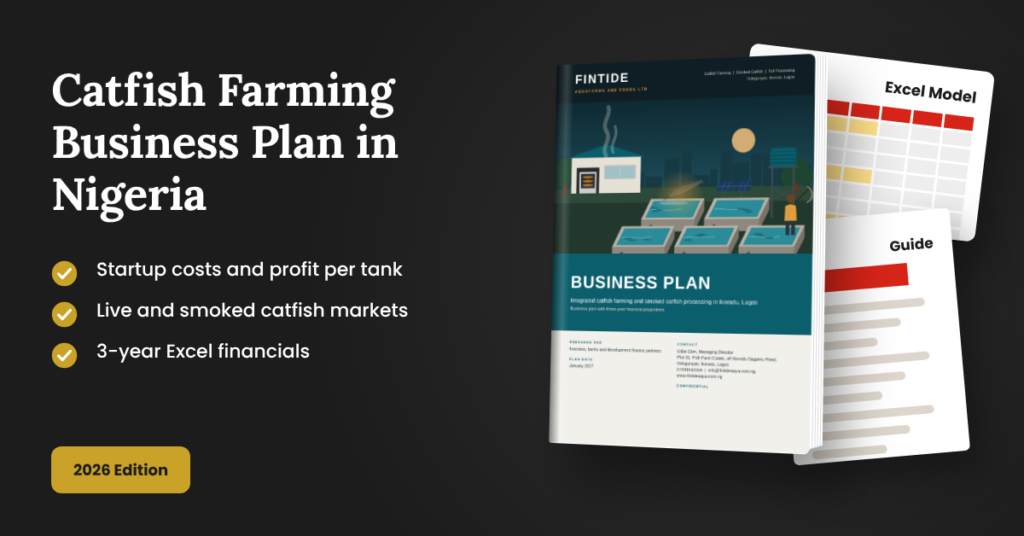
Catfish is the fish Nigeria grows best, and still not enough of it. If you are searching for a catfish farming business plan in Nigeria, you probably already know the opportunity. What you need is the honest picture: what it costs to start, how the money is made, where farms lose it, and how to put it all in a plan a bank will take seriously.
This guide walks you through all of it with real 2026 Lagos numbers. At the end, you will find our readymade Catfish Farming and Processing Business Plan, a complete pack you can edit and submit, if you want the shortcut.
Why catfish farming still makes sense in 2026
Nigeria eats far more fish than it produces. The Minister of Marine and Blue Economy put national demand at about 3.6 million tonnes a year against local production of 1.4 million tonnes in 2025 (BusinessDay). The gap of more than 2 million tonnes is filled with imports that cost the country over 1 billion US dollars a year, according to IFPRI.
Catfish carries Nigerian aquaculture. It reaches table size in five to six months, tolerates high stocking densities and sells in almost every market in the country. In November 2026, fresh catfish traded at about ₦4,000 per kg, and Lagos retail prices run from ₦5,000 to ₦7,000 per kg. Clean, packaged smoked catfish sells online for ₦10,500 to more than ₦20,000 per kg.
The demand is there. The question is whether your farm can produce at a cost that leaves profit, and sell without being forced to dump fish on harvest day.
What it costs to start a catfish farm and processing business
Our sample plan models a farm with 12 concrete tanks in the Ikorodu fish farming cluster, each stocked with 1,800 post-juveniles, plus a processing shed and a 300kg smoking kiln. Here is how the budget breaks down.
| Item | Amount (₦) |
|---|---|
| Tanks, borehole, processing shed and fence | 17,100,000 |
| Farm and processing equipment (kiln, solar pumping, generator, tools) | 9,400,000 |
| Office container, IT and furniture | 2,200,000 |
| Standing fish stock (juveniles and feed before the first harvest) | 12,800,000 |
| Pre-opening wages, permits, NAFDAC, launch marketing, legal | 6,730,000 |
| Working capital reserve | 4,500,000 |
| Total project cost | 52,730,000 |
Notice the standing fish stock. Fish take about five months to reach table size, so you pay for juveniles, feed and wages long before your first sale. Many new farmers forget this line and run out of cash in month four.
Starting smaller? You do not need ₦52.7 million to begin. Plenty of successful farmers start with two to four tarpaulin or concrete tanks behind the house and a small drum kiln, then grow from the profit. The same logic applies at any size; only the numbers change.
How a catfish farm actually makes money
Stagger your stocking
The single most important idea in our plan is staggered stocking. Instead of filling every tank at once, you stock two tanks every month and harvest two tanks every month. That gives you fish, cash and customers every month, and it lets you win standing orders from restaurants and traders who need steady supply.
The maths of one tank
One tank stocked with 1,800 fish, at 88% survival and an average harvest weight of 1.2kg, gives about 1,901kg of table-size fish. At a feed conversion ratio of 1.1 and feed at a bulk price of ₦1,650 per kg, the direct cost is about ₦2,038 per kg. Sold at ₦4,000 per kg at the farm gate, one tank earns a gross profit of about ₦3.7 million per cycle before overheads.
Feed is about 89% of that direct cost. That is why a good farm manager weighs feed, never scoops it, and tracks feed conversion in every tank every week.
Four prices for the same fish
Processing changes what a kilogram of fish can earn. It takes about 2.8kg of fresh catfish to make 1kg of smoked catfish. Measured per kilogram of fresh fish:
- Live at the farm gate: ₦4,000
- Live, graded and delivered to restaurants and hotels: ₦4,500
- Smoked in 10kg bulk cartons: about ₦4,290
- Smoked in branded 500g retail packs: about ₦5,890
Bulk smoking earns about the same as selling live, but it protects you. When traders push prices down at harvest, you smoke the surplus and sell it later. The retail packs are where processing adds real margin.
See the full Catfish Farming and Processing Business Plan
What the numbers look like over three years
With prices held flat for three years, our model shows revenue of ₦121.0 million in Year 1, ₦159.2 million in Year 2 and ₦175.6 million in Year 3. Net income is ₦4.8 million in Year 1, after company income tax, rising to ₦14.9 million and ₦18.5 million. Debt service cover is 1.91 times in Year 1 and above 3 times from Year 2, and the project pays back in about 2.5 years.
We also stress-tested the plan. Even with volumes 20% lower and prices 10% lower at the same time, the business needs only a ₦1.3 million overdraft and returns to profit in Year 2.
Licences and regulations you need
- CAC registration of your business name or company.
- Tax identification with the Nigeria Revenue Service. Under the Nigeria Tax Act 2025, companies with turnover of ₦100 million or less pay 0% company income tax.
- State fish farm registration with your state Ministry of Agriculture (in Lagos, the Ministry of Agriculture and Food Systems).
- Business premises permit from your state or local government.
- NAFDAC listing if you sell packaged smoked catfish to supermarkets.
- Environmental compliance for waste water and fish offal (LASEPA in Lagos).
- Food handler medical certificates for anyone processing fish.
The biggest risks, and how to manage them
- Feed price spikes: buy in bulk from two distributors, hold two weeks of stock and track feed conversion.
- Harvest gluts: stagger stocking, lock in restaurant orders, and smoke surplus fish.
- Disease: buy from vetted hatcheries, quarantine new stock, test water daily and keep a fish health consultant on call.
- Flooding: Ikorodu farmers lost about ₦150 million to floods in 2025. Raise tank walls, clear drains and harvest early in the peak rainy months.
- Cash running out before the first harvest: budget for at least five months of juveniles, feed and wages.
How to write your catfish farming business plan
A lender or grant panel wants to see that you understand the market, the production cycle, your costs and your cash flow. A strong plan covers:
- Executive Summary: the business, funding request, use of funds and three-year highlights.
- Company Overview: profile, founder background, mission, vision and location.
- Products and Services: live fish, smoked fish and any services, with prices.
- Industry Analysis: Nigeria’s fish gap, the catfish and smoked fish markets, drivers and challenges.
- Market and Competition: your customers, named competitors, positioning and SWOT.
- Marketing and Sales: pricing, channels, promotion, seasonality and budget.
- Operations: stocking, feeding, sorting, water quality, processing and suppliers.
- Management: team, staffing and pay.
- Risk Analysis: what can go wrong and your fix for each.
- Financial Plan: unit economics, profit and loss, cash flow, balance sheet, break-even and sensitivity.
- Funding and Timeline: the funding request, security and a month-by-month launch plan.
Writing all of that from scratch, with current prices and a working financial model, takes weeks. That is why we built a readymade version.
Get the readymade Catfish Farming and Processing Business Plan
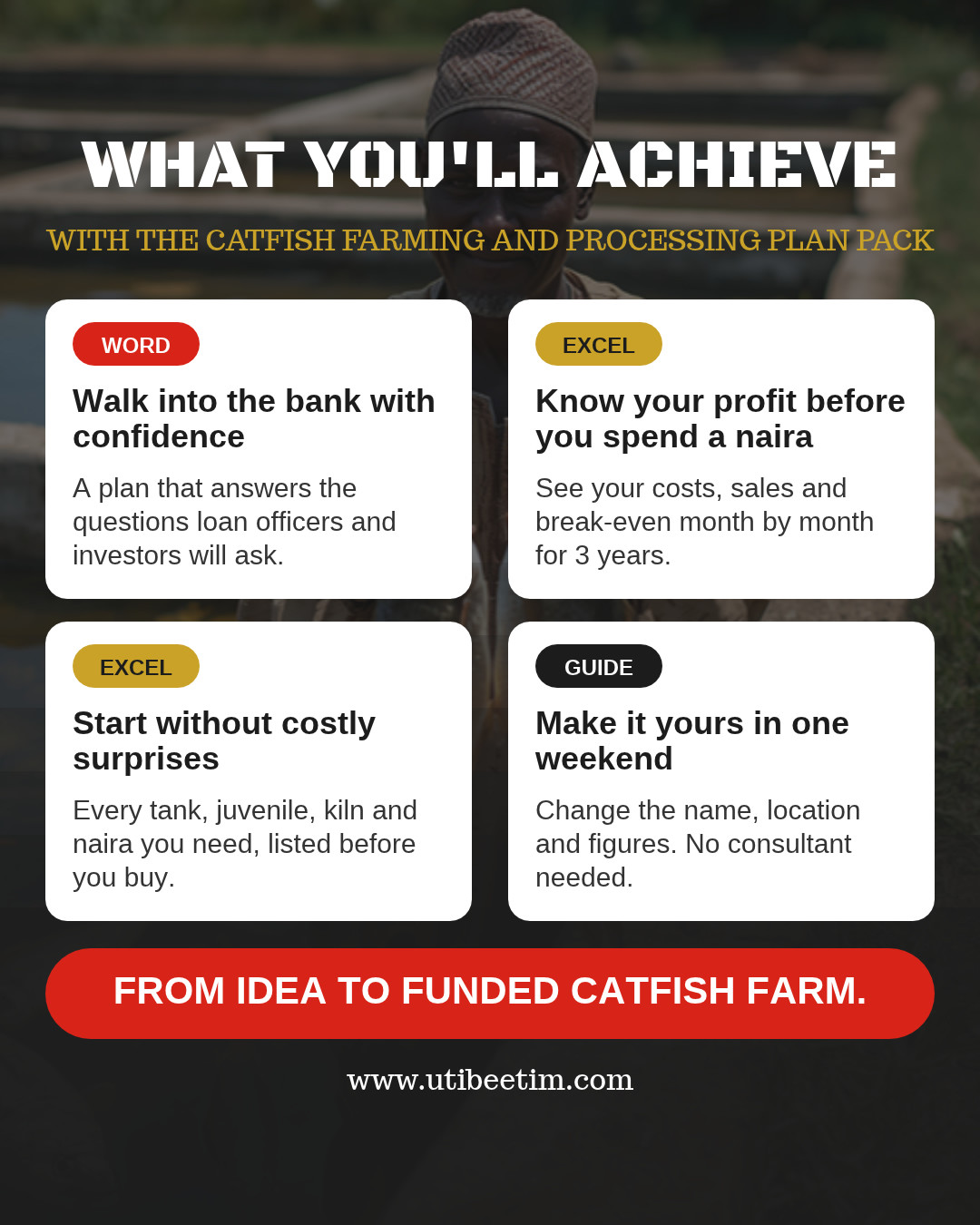
Our pack gives you everything above, done and editable:
- 51-page business plan in Word and PDF, with 13 editable charts and an editable cover.
- 3-year financial workbook in Excel: start-up costs, monthly sales, payroll, profit and loss, cash flow, balance sheet, break-even, lender ratios and stress tests.
- Startup checklist with 63 launch tasks, costs and a progress tracker.
- Buyer customisation guide that shows you how to edit everything, step by step.
Every section and every figure can be increased or reduced to fit you. Change the number of tanks, prices, feed cost, staff and funding in the workbook, and the profit, cash flow and charts update for you. Scale it down to a home-based farm, or move it to your own state.
Prefer a plan written for your own farm?
If you are about to submit to a bank, BOA, a grant or an investor, a custom business plan built around your farm, location, capacity and funding is the stronger option. We research your market, build your numbers with you and deliver a unique, bank-ready plan. We have written more than 1,200 custom plans since 2012. See our custom business plan packages or call or WhatsApp 07031542324.
Frequently asked questions
How much does it cost to start catfish farming in Nigeria?
A small backyard farm with two to four tanks can start for a few million naira. A commercial farm with 12 concrete tanks and a smoking kiln, as in our plan, costs about ₦52.7 million including the first fish stock and working capital.
How long does catfish take to reach table size?
Post-juveniles of 10g to 15g reach 1.0kg to 1.4kg in about 20 weeks on good floating feed.
Is catfish farming profitable in Nigeria?
Yes, when feed conversion, survival and selling are managed well. In our model one tank earns about ₦3.7 million gross profit per cycle at farm-gate prices.
Why add processing to a catfish farm?
Smoking lets you hold fish when live prices fall, sell to buyers far from the farm, and earn more per kilogram through branded retail packs.
Can I edit the readymade plan?
Yes. The plan is in Word and the financials are in Excel. Every name, number, chart and page can be changed, and the guide shows you how.
Get the Catfish Farming Business Plan
Looking for something related? See our full list of readymade business plans.