
Walk into any perfume workshop in Lagos Island, a sanitiser factory in Ikeja or a herbal medicine company in Ogun State, and ask where they buy their ethanol. Most will name a trader in Ojota or Isolo. Ask whether that trader gives them a certificate of analysis, a sealed container and a delivery date they can trust, and the answer is usually no.
That is the opening for a well-run ethanol supply business in Nigeria. This guide shows you how the business works, what it costs to start in 2027, how it makes money, the licences you need, the risks to manage, and how to put it all into an ethanol supply business plan a bank or investor will take seriously.
The figures below come from our new Ethanol Supply and Distribution Business Plan, built around a documented ethanol supply company in Lagos using current October 2026 prices.
Why ethanol supply is a real opportunity in Nigeria
Nigeria has long imported most of the ethanol it uses. The Guardian reported that the country imported 300 to 350 million litres a year while its main local producers made only a fraction of that. BusinessDay later put national demand at about 400 million litres a year, with local supply meeting roughly 6 percent.
Ethanol goes into perfumes and body sprays, hand sanitisers, herbal and pharmaceutical products, paints and inks, cleaning products and laboratories. The big manufacturers buy direct from producers and importers. The thousands of small and mid-sized users can’t, so they depend on traders.
Three trends make this the right time to enter:
- Cosmetics are booming. New perfume, body spray and skincare brands launch every month, and most buy ethanol by the jerrycan.
- Sanitiser is now a standard product. Hygiene habits from COVID-19 created steady base demand from retailers, schools and offices.
- Buyers want proof. NAFDAC and corporate customers ask harder questions about raw materials, so a supplier with documents wins over a supplier with only a low price.
In Lagos and Ogun States alone, we estimate about 1,200 small and mid-sized businesses buying under 2,000 litres a month, a market of roughly 5.8 million litres a year.
How an ethanol supply business makes money
You buy ethanol in sealed 200-litre drums from approved producers and importers, check it, store it safely and sell it on. There are two ways to earn:
- Whole drums to larger buyers such as pharmaceutical and paint companies. The margin is thin, around 11 percent, but the volumes are big.
- Sealed 25-litre jerrycans to small perfume makers, sanitiser producers and labs. You decant drums safely into new jerrycans, label them and deliver. The margin is about 24 percent, because small buyers pay for convenience, documentation and reliable delivery.
In our plan, pharma grade drums cost about ₦1,380 per litre and sell at ₦1,650, while jerrycans sell at about ₦2,120 per litre. Getting the mix right between drums and jerrycans is what decides your profit.
How much does it cost to start an ethanol supply business?
Here is the start-up budget for the standard model in our plan: a fitted store in Lagos, safe decanting, opening stock and enough cash to carry customers on short credit.
| Item | Amount |
|---|---|
| Store fit-out (bunded floor, flameproof lighting, ventilation, decanting area, signage) | ₦1,400,000 |
| Equipment (drum pumps, earthing kit, scale, alcoholmeters, extinguishers, spill kits, trolleys, spill pallets) | ₦1,500,000 |
| Furniture, computer, printer and stock software | ₦900,000 |
| Opening stock | ₦4,000,000 |
| Licences and permits | ₦650,000 |
| Rent deposit and lease costs | ₦750,000 |
| Legal, accounting and registration | ₦400,000 |
| Insurance deposit | ₦350,000 |
| Jerrycans, labels, PPE and supplies | ₦450,000 |
| Pre-opening salaries, utilities deposit and other start-up costs | ₦900,000 |
| Launch marketing | ₦350,000 |
| Working capital (cash on hand) | ₦3,300,000 |
| Total project cost | ₦14,950,000 |
The plan funds this with ₦9,950,000 of owner equity and a ₦5,000,000 term loan at 27 percent over three years.
Can you start smaller?
Yes. You can start as a drum-only trader with a small compliant store for about ₦6.5 million, then add jerrycan decanting once your customers ask for it. You can also broker drums straight from the producer to large buyers with very little capital while you raise money for a store. Every figure in the plan can be reduced or increased to match your budget.
What the numbers look like over three years
- Year 1 revenue: ₦271.8 million, rising to ₦476.1 million in Year 3
- Gross margin: about 20 percent across the product mix
- Net profit: ₦5.8 million in Year 1, ₦19.7 million in Year 2 and ₦26.4 million in Year 3
- Debt service cover in Year 1: 3.7 times, well above what most lenders ask for
- Payback period: about 1.4 years
Revenue looks large because ethanol is a high-volume, low-margin trade. That is exactly why your plan must show the bank that you understand cash flow, credit control and stock turnover. The stress tests in the plan show what happens if volumes fall 20 percent, if prices drop, or if landed costs rise and you fail to pass them on.
Licences and regulations you need
Ethanol is a flammable liquid, so you must set up properly before your first delivery. Expect to deal with:
- CAC company registration and tax registration with the FIRS and the Lagos State Internal Revenue Service
- A fire safety certificate from the Lagos State Fire and Rescue Service for your store
- Lagos State Safety Commission requirements for workplace safety
- LASEPA environmental and waste management requirements
- Documents for customers who make NAFDAC-regulated products, such as certificates of analysis and safety data sheets
- Business premises permit and signage approvals from your local government
Fuel-sector licences do not apply if you trade only industrial ethanol and not fuel.
The biggest risks and how to manage them
- Fire and spills. Store only sealed containers, use flameproof lighting, bond and earth every transfer, ventilate the store and train every staff member.
- Fake or diluted product. Buy only from approved suppliers, check seals, test strength with an alcoholmeter and reject any batch without a certificate of analysis.
- Diversion into illicit drinks. Verify every customer’s CAC documents, address and end use. Stop the sale when the story doesn’t add up.
- Bad debts. Take prepayment from new customers, set credit limits and suspend supply when a payment is seven days late.
- Rising landed costs. Update prices within the week whenever your cost rises by more than 2 percent.
How to write your ethanol supply business plan
A bank or investor will want to see your market, your suppliers, your safety systems, your team and three years of financial projections that add up. Writing that from scratch takes weeks.
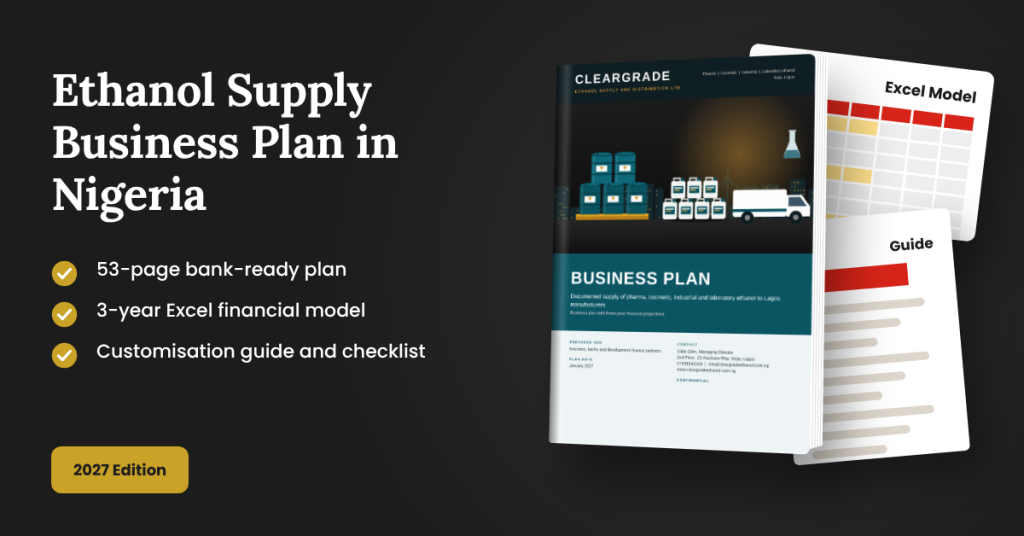
Our readymade Ethanol Supply and Distribution Business Plan gives you all of it, ready to edit. Here is what is inside the plan:
- Executive Summary: the business, the opportunity, funding needed and the key results.
- Company Description: legal status, mission, vision, ownership, objectives and growth phases.
- Products and Services: the ethanol grades, packaging, quality specifications and value proposition.
- Industry and Market Analysis: the Nigerian ethanol market, customers, competitors, SWOT and market share.
- Business Model and Sales Strategy: revenue streams, unit economics, pricing, sales channels and credit control.
- Marketing Plan: positioning, channels, budget and the first 90 days of customer acquisition.
- Operations Plan: supplier approval, quality testing, safe storage and decanting, delivery and the roadmap.
- Management and Staffing: the team, roles, salaries and organisation chart.
- Risk Analysis and Compliance: safety, supply, credit and financial risks, stress tests, permits and insurance.
- Financial Plan: start-up costs, funding, income statement, cash flow, balance sheet, break-even, ratios and loan schedule.
- Appendices: supporting schedules and templates.
You also get the 3-year financial model in Excel, a buyer customisation guide and a startup checklist with costs and a progress tracker. Every section and every figure can be changed to suit your own business, and the Excel model updates the numbers for you.
Price: ₦16,125 (was ₦32,500). Instant download after payment. See full details of the plan.
Need a plan written specifically for your business, location and funding target? Our team writes unique, lender-ready business plans with support until you submit. See our custom business plan packages, or browse more than 130 readymade business plans in other niches.
Frequently asked questions
How much do I need to start an ethanol supply business in Nigeria?
The standard model in our plan costs about ₦14.95 million, including store fit-out, equipment, opening stock, permits and working capital. A smaller drum-only start is possible from about ₦6.5 million.
Is ethanol supply profitable?
Yes, if you manage it well. Drum sales earn around 11 percent and jerrycan sales around 24 percent. Our plan projects net profit of ₦5.8 million in Year 1 rising to ₦26.4 million in Year 3.
Where can I buy ethanol in bulk in Nigeria?
From local producers, licensed importers and their authorised distributors. Always ask for a certificate of analysis for every batch and visit the supplier before your first order.
Do I need NAFDAC registration to sell ethanol?
Ethanol you resell as a raw material is not usually registered as a finished product. But customers who make NAFDAC-regulated products will need your certificates of analysis, safety data sheets and batch records for their own files, so keep them for every batch.
Can I edit the business plan?
Yes. The plan is in MS Word and the financial model is in Excel. You can change the name, location, prices, volumes, staff and funding to match your business.
Start your ethanol business on the right foot
Ethanol supply rewards people who take quality, safety and paperwork seriously. Get those right and you have a business with steady repeat orders from manufacturers who can’t afford to run out. Start with a plan that shows you, and your bank, exactly how it works.
Questions? Call or WhatsApp 07031542324.