
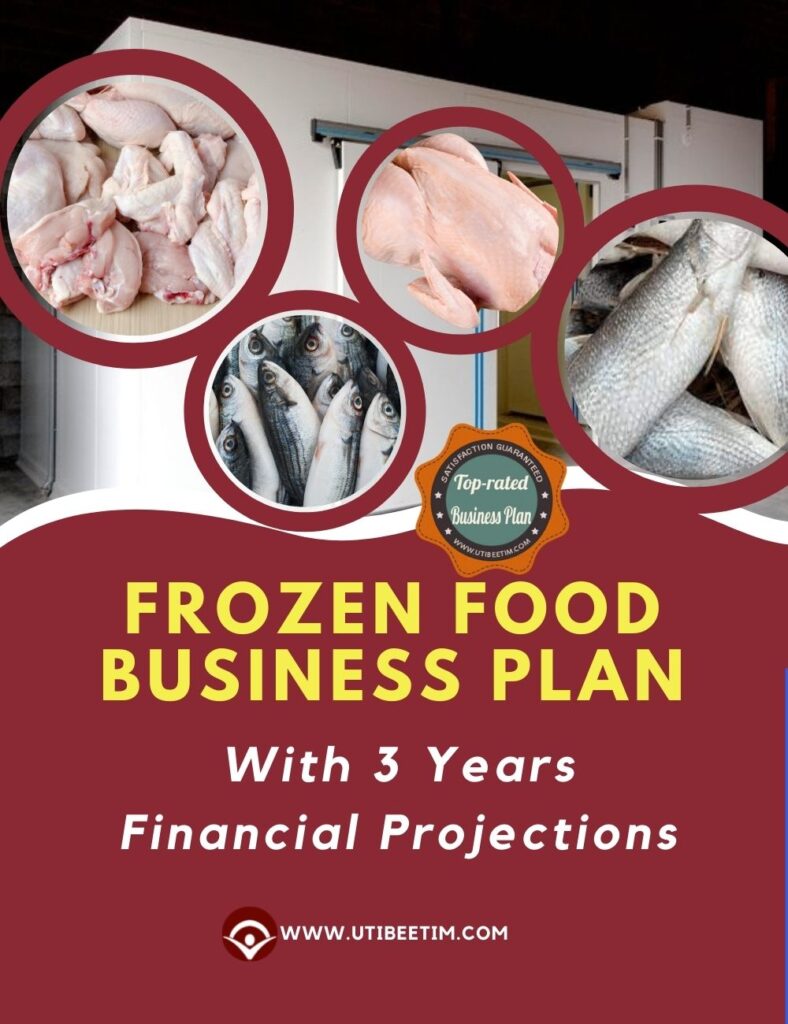
Walk through any Lagos neighbourhood and you will find a cold room. A humming freezer, a generator outside, cartons of chicken and titus stacked to the ceiling, and a queue on Saturday morning.
It looks simple. Buy cartons, freeze them, sell them. That is why so many people start one, and why so many quietly close within a year.
The cold room business in Nigeria is not won by the person with the biggest freezer. It is won by the person who keeps stock frozen at a sensible power cost, buys close to source, prices by the week and sells by the kilo. Miss one of those and the thin margin disappears.
This guide walks you through all of it, using real 2026 Lagos numbers: the market, how frozen food moves from the port to the plate, who buys, who you compete with, what it costs to start, how the money is made, how to deal with power, and the risks that kill cold rooms. At every step we show you what we built into our own readymade plan, so you can see the advice turned into a business you can fund.
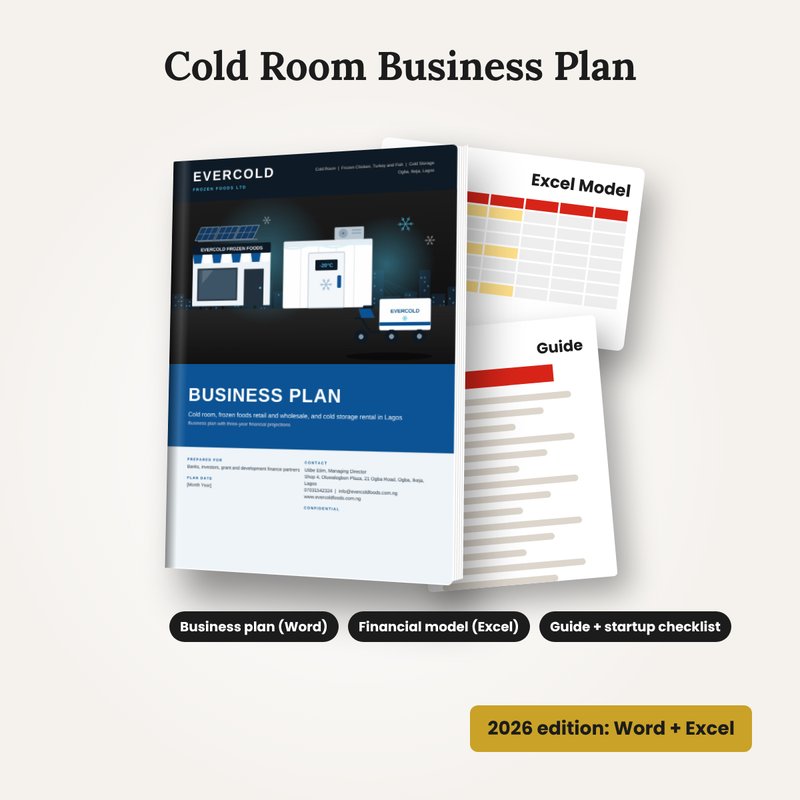
Short on time? Everything in this guide is built into our Frozen Food and Cold Room Business Plan (2026 edition): a 48-page bank-ready plan in Word, a 3-year financial model in Excel, a buyer customisation guide and a 62-task startup checklist. All editable, so you can fit it to your location and budget.
Original price was: ₦32,500.00.₦16,125.00Current price is: ₦16,125.00.Order Now
Why we rebuilt this plan from scratch
For over 10 years we have written business plans for Nigerian founders: more than 1,200 custom plans and over 5,000 readymade plans sold. We have also sat on the other side of the table, as a pioneer YouWIN awardee, a Kickstart and Lagos State Empowerment Fund grantee, and a Tony Elumelu Foundation mentor.
Our cold room plan was one of our most popular. But it was written in 2021, and readers noticed. One asked in the comments if we had a 2026 version with full details on installation. Fair question. A plan built on 2021 prices, a generator-only power setup and an old tax regime is not a plan you should take to a bank in 2026.
So we did not touch up the old one. We threw it out and rebuilt it: new market research, October 2026 equipment and carton prices, a solar power plan, the Nigeria Tax Act 2025, real Lagos competitors and a brand new 3-year financial model.

Is the frozen food business still profitable in Nigeria?
Yes, if you run it as a volume business with tight control of power, buying and pricing. The demand side is not the problem. Here is why.
The fish gap is huge. Nigeria needs more than 3.6 million tonnes of fish a year. Domestic production was about 1.4 million tonnes in 2025, which leaves a gap of more than 2 million tonnes every year. Most of that gap is filled with frozen mackerel (titus), herring and other imports that pass through cold rooms before they reach the kitchen. Fish imports cost about 1.2 billion US dollars in 2025.
Frozen chicken is now a local business. Frozen poultry imports have been banned since 2003, so legal frozen chicken and turkey come from Nigerian processors and integrated farms. In September 2026 a carton of local chicken laps sold for about ₦48,000 in Lagos against about ₦62,000 for smuggled imported brands. Local supply is cheaper, legal and traceable, which is exactly what a bank and a food business want to see.
Squeezed households buy smaller, more often. Food inflation was 19.59% in September 2026. Families now buy 1kg or 2kg at a time instead of a full carton. That favours a clean cold room close to home that sells by the kilo.
The cold chain is badly underbuilt. Nigeria loses 30% to 50% of its fish, fruit and vegetables after harvest, worth ₦3.5 trillion to ₦5 trillion a year. The country runs fewer than 1,000 refrigerated trucks against a need of about 25,000. Well-run cold rooms close to consumers are part of the answer.
Solar has changed the maths. Lithium batteries and hybrid inverters are now practical for a small operator. That single change turns many marginal cold rooms into profitable ones, as you will see below.
In our plan: Chapter 4 (Industry Analysis) covers the frozen foods industry, the fish supply gap, frozen poultry, the cold chain gap, industry drivers and challenges, and the full regulatory environment, with a chart of fish demand against supply and every figure sourced.
How frozen food moves in Lagos: the distribution chain
Before you rent a shop, understand where you sit in the chain. Frozen protein in Lagos moves through three layers:
- Importers, processors and big distributors. They move product by the container and the truckload. Fish importers cluster around Apapa, Ijora and Oyingbo. Chicken and turkey come from Nigerian poultry processors and integrated farms.
- Wholesale cold rooms and markets. They buy hundreds of cartons and sell by the carton. The main clusters are Ijora, Apapa, Oyingbo, Mile 12 and Agege.
- Neighbourhood cold rooms and frozen food shops. They buy a few dozen cartons at a time and sell by the kilogram to households, buka, suya spots, canteens and caterers.
The smart place for a new operator is layers two and three together: retail by the kilo as the anchor, carton wholesale to food businesses as the volume driver. You get the high margin of retail and the steady volume of trade.
Your buying decides your profit. If you buy from market traders in layer two and sell in layer three, you are squeezed from both sides. Buy in bulk direct from processors and licensed distributors instead, and you land stock 5% to 8% below the Lagos market carton price. In a business with a gross margin of about 22%, that is the difference between profit and loss.
Your outbound distribution decides your reach. Retail customers come mostly from within 3km of the shop. Trade and storage customers will travel or order from about 7km away. Plan for both: a shop that households can walk to, and a delivery system for cartons. In year one that can be a field sales rep with dispatch riders and hired vehicles, with cartons in insulated boxes and ice packs. As volumes grow, an insulated-box cargo tricycle cuts the cost per delivery and puts your brand on the road.
In our plan: the sourcing section names the supplier types, the rule of two active suppliers for every main product and the NAFDAC documents to keep on file. Logistics and delivery are budgeted at ₦3.6 million in Year 1, with an insulated-box tricycle added in Year 2. Appendix C gives you a supplier receiving checklist you can print and use from day one.
Who buys from a cold room
A cold room serves four kinds of customer. Plan for each one separately, because they buy differently.
- Households: working families and young professionals near the shop. They want clean, properly frozen protein, honest weight and the option to buy 1kg or 2kg. More of them now order on WhatsApp.
- Food businesses: buka and mama-put kitchens, canteens, suya and shawarma spots, small restaurants and pepper soup joints. They buy by the carton, care about steady supply and price, and switch suppliers the day stock arrives soft or short.
- Caterers and event planners: large orders around weekends and festive seasons, often needing a few days of cold storage before an event.
- Small retailers and traders: mini-marts and market traders who buy a few cartons to resell, and who rent space from you when their own freezers are full or their power is out.
Buyers decide on four things: price, freshness (stock that has not thawed and refrozen), honest weight and availability. Retail peaks on Fridays and Saturdays and before Christmas, Easter and Sallah. Trade buying is steadier through the week.
Do the market sizing in customers, not in billions. Our model needs about 59kg of retail sales a day in the first month. If a typical household buys 2kg a visit, that is about 29 customers a day, a small share of the tens of thousands of households within 3km of a busy Lagos road. Wholesale needs about 4 cartons a day at launch, which 40 to 60 regular trade accounts can deliver. That is the kind of sizing a loan officer believes.
In our plan: Chapter 5 (Market and Competition) sets out the four target segments, geographic coverage by radius, a bottom-up market sizing for the catchment, buying behaviour and a seasonal pattern you can plan stock around.
Your competition, and how to win
You will not win on price. The big markets at Ijora and Oyingbo will always be cheaper by the carton. Here is who you are really up against in a typical Lagos neighbourhood:
| Competitor | Their strength | Where you win |
|---|---|---|
| Other neighbourhood cold rooms | Close to customers, long relationships | Reliable power, no thaw and refreeze, a clean shop and honest scales |
| Ijora, Apapa and Oyingbo markets | Lowest carton prices, huge range | Small buyers avoid the distance and traffic; you sell by the kilo and deliver |
| Supermarkets (Shoprite, Justrite) | Brand trust, clean stores, card payments | Lower prices, a wider fish range, cutting service and trade prices |
| Online grocers | Home delivery convenience | Lower prices and same-day pickup |
| Large cold storage operators | Big palletised capacity | You rent by the carton-week to small traders who need 5 to 50 cartons |
Your edge is trust. A household that once bought soft, refrozen chicken will pay a fair price never to have that experience again. An eatery that runs out of chicken on a Friday night will switch to the supplier who always has stock.
In our plan: named Lagos competitors with their strengths and gaps, a positioning statement you can adapt, and a full SWOT analysis.
What you can sell: one cold room, six ways to earn
Most people think a cold room sells chicken. A well-run one earns from six streams:
- Frozen chicken sold by the kg
- Turkey wings sold by the kg
- Titus (mackerel) sold by the kg
- Croaker and kote sold by the kg
- Wholesale cartons to eateries, caterers and hotels
- Cold storage space rented to traders by the carton per week
Add free cutting and cleaning at the counter. It costs you little and it is the reason many customers choose you over the supermarket.
Here is the maths that matters most. One 10kg carton of chicken, cut and sold by the kilo, earns about ₦16,500 gross profit. The same carton sold whole to an eatery earns about ₦6,000.

| Product line | Gross margin in our model | Role in the business |
|---|---|---|
| Chicken by the kg | About 26% | The profit engine |
| Titus by the kg | About 24% | The everyday fish line |
| Wholesale cartons | About 11% | Volume, stock turn and trade loyalty |
| Cold storage rental | About 75% | Earns money from space you would leave empty |
Retail makes the margin. Wholesale keeps stock moving so nothing sits too long. Storage rental helps pay the power bill. Together, gross margin across the business is about 21.8%, which is normal for food distribution.
In our plan: Chapter 3 (Product Range and Services) describes all six lines, the pricing structure, the cutting and delivery services and the quality controls. Each line has its own price, cost, daily capacity and sales ramp in the Excel model, so you can switch any line off or add your own.
How much does it cost to start a cold room business in Lagos?
For a small walk-in cold room (10 x 8 x 8 ft, about 5 to 6 tonnes of stock) with a retail shop front, the honest October 2026 budget is about ₦38.1 million.

| Item | Cost (₦) |
|---|---|
| Walk-in cold room, 100mm PU panels, 3HP condensing unit, supplied and installed | 8,500,000 |
| Solar hybrid backup: 10kVA inverter, 15kWh lithium batteries, 6kWp panels | 6,800,000 |
| 10kVA soundproof diesel generator (emergencies only) | 3,000,000 |
| Display chest freezer, band saw, scales, CCTV, stabiliser, temperature logger | 3,570,000 |
| Shop fit-out: insulated floor base, tiling, rewiring, burglary proofing, signage | 2,300,000 |
| Furniture, laptop, POS software and safety gear | 1,450,000 |
| Opening stock (about one week of sales) | 4,500,000 |
| Rent deposit, legal, licences, insurance, supplies, pre-opening salaries | 3,380,000 |
| Launch marketing | 600,000 |
| Working capital (cash cushion) | 4,000,000 |
| Total | 38,100,000 |
In our model the owner puts in ₦15.1 million (about 40%) and a 48-month term loan covers ₦23 million.
Working with a smaller budget? You have real choices:
- Start with chest freezers and an inverter. Sell by the kilo, build your customer list and trade accounts, then move up to a walk-in room with proof of demand.
- Size the cold room to your demand. 2026 quotes for small cold rooms in Nigeria run from about ₦5 million to ₦15 million depending on size and specification.
- Phase your equipment. A second display freezer and a delivery tricycle can wait until Year 2, as they do in our plan.
What you should never cut is the power backup and the cash cushion. Those two keep you alive in the first six months.
In our plan: every item sits on its own line in the Excel model, with the full schedule in Appendix A. Change the room size, solar size, stock or rent, and the revenue, cash flow and loan figures all update. The buyer guide shows you how to carry the new numbers into the Word plan.
Power: the decision that makes or breaks a cold room
Run a small cold room on a diesel generator alone and you can spend about ₦2.6 million a month on fuel at 2026 prices. Diesel sold at about ₦1,775 a litre at depot level in October 2026. That single line wipes out the profit of most small cold rooms, and every outage softens your stock.

The setup that works in 2026 has three layers:
- Grid first. A dedicated prepaid meter, ideally on a Band A feeder.
- Solar with lithium batteries. Solar carries much of the daytime load, and when the grid fails the batteries take over with no break in cooling.
- Generator for emergencies only. It runs only when a long outage meets a low battery.
With this setup our model budgets electricity, diesel, water and waste at about ₦420,000 a month. Add a digital temperature logger that sends an alarm to your phone if the room warms up, and you will know about a problem before your customers do.
In our plan: Chapter 7 (Operations Plan) includes the cold room specification, the three-layer power plan with costs, the equipment list, maintenance schedule, a spares kit and operating targets, including keeping the room at minus 18°C or colder for at least 99% of logged hours.
Running the cold room day to day
The operation is simple when it is disciplined: buy right, receive carefully, keep everything frozen, sell fast and count every day.
- Receive with a checklist. Check core temperature, carton condition, labels and invoices on every delivery. Reject anything soft.
- First in, first out. Date-label every carton and move small batches to the display freezer so nothing sits on the counter.
- Turn stock every 5 to 7 days. Opening stock of about one week of sales is enough. More just ties up cash.
- Never sell refrozen stock as frozen. One bad carton loses a customer for life.
- Count and reconcile daily. Fast-moving lines every evening, cash and POS to zero variance, a daily report on the owner’s phone by 9pm.
- Keep it visibly clean. Separate boards for fish and poultry, food handler certificates for every staff member, and a monthly defrost and deep clean.
In our plan: a daily operating workflow, an hour-by-hour daily routine, inventory and shrinkage rules, food safety controls and KPIs. Chapter 8 adds the team: six salaried roles from managing director to field sales and delivery rep, with an organisation chart, job profiles and full payroll including pension, NSITF, ITF and HMO.
Marketing a cold room: being first choice within 3km
You do not need to be famous. You need to be the first cold room people think of near your shop, and the supplier 60 food businesses call every week.
- WhatsApp Business is your main sales tool. A catalogue with daily prices, broadcast lists for households and trade customers, and status updates when fresh stock lands.
- Visit the food businesses. A field rep with a price list and a free sample pack, visiting 100 vendors in the first quarter, builds your wholesale book faster than any advert.
- Geo-targeted social ads. Small Facebook and Instagram campaigns within 5km, focused on weekend deals and festive packs.
- Flyers and estate visits in the first three months, at estates, churches, mosques and bus stops.
- Loyalty that is easy to track. For example, 1kg free for every 20kg bought, logged against the customer’s phone number on the POS.
- Price weekly. Review prices every Monday and protect your margin per kilogram, not your shelf price.
Keep marketing lean. Food retailers typically spend 1% to 3% of sales on marketing. With a gross margin near 22%, the 6% to 8% norm for service businesses would wipe out your profit.
In our plan: Chapter 6 (Marketing and Sales Strategy) covers marketing objectives, the weekly pricing rule, sales channels (walk-in retail brings about 68% of Year 1 revenue), promotion, customer retention, a marketing budget and a seasonality calendar for Christmas, Easter and Sallah.
Licences and permits you need in Lagos
- CAC registration as a limited company. We can register your business for you.
- Tax registration with the Nigeria Revenue Service and Lagos State IRS
- Business premises permit from the Lagos State Ministry of Commerce or your local government
- Environmental health inspection and food handler certificates for all staff
- Signage permit from LASAA
- Fire safety certificate from the Lagos State Fire and Rescue Service
- Waste collection by a LAWMA-approved operator
- Pension, NSITF and ITF registration with your first payroll
Buy only NAFDAC-registered or licensed products and keep the documents on file. Unprocessed frozen chicken, turkey and fish are basic food items, so your prices are not loaded with VAT.
In our plan: a licences and permits table with the authority for each one, a regulatory checklist in Appendix D, and every registration step in the startup checklist with its cost.
What the numbers look like
A lender will look at the same things every time: revenue growth, profit, cash, break-even and whether you can repay the loan. Here is what our model shows for the ₦38.1 million cold room:
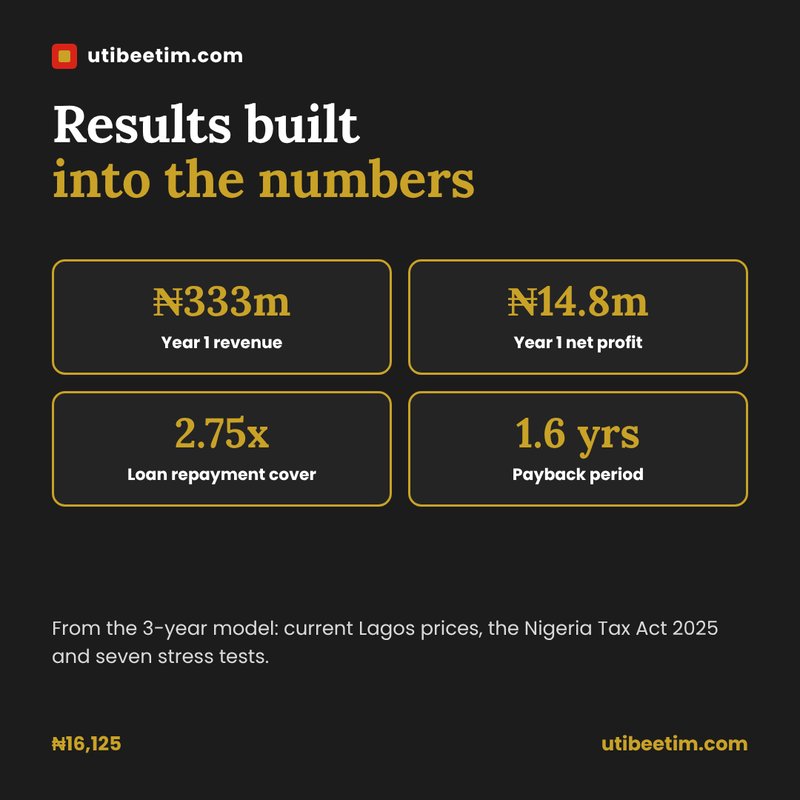
- Revenue: ₦333.0 million in Year 1, rising to ₦528.0 million in Year 3
- Net profit after tax: ₦14.8 million in Year 1, ₦26.9 million in Year 2 and ₦37.1 million in Year 3
- Break-even: about ₦226.5 million of revenue a year, and monthly revenue is above it from the first month of trading
- Debt service cover: 2.75x in Year 1, rising to 5.02x by Year 3
- Payback: about 1.6 years
- Cash: at least ₦4.4 million at every month-end in the forecast
The revenue looks big because frozen food is a volume business. Out of every ₦100 of sales, about ₦78 goes straight back to suppliers for stock. That is why net margin is about 4% to 7%, and why buying, power and pricing discipline matter so much.
On tax, the Nigeria Tax Act 2025 gives small companies with turnover below ₦100 million and fixed assets below ₦250 million a 0% company income tax rate. A cold room at this scale passes ₦100 million in its first year, so our model applies 30% company income tax plus the 4% development levy.
In our plan: Chapter 10 (Financial Plan) has the income statement, cash flow, balance sheet, break-even analysis, lender ratios and 13 editable charts, all linked to the Excel model, plus a Year 1 monthly summary in Appendix B.
The risks that kill cold rooms, and how to manage them
1. Power. Covered above. Diesel alone can cost ₦2.6 million a month. Build grid, solar and batteries in from day one.
2. Supplier prices that jump. This is the biggest financial risk. In our stress test, if your landed cost rises 15% and your shelf prices stay the same, Year 1 turns into a loss of about ₦9.3 million. The fix is simple and non-negotiable: reprice every Monday based on what you paid last week.
3. Slow sales. If sales come in 20% below plan but margins hold, our model still makes about ₦5.9 million in Year 1. Volume shortfalls hurt, but price discipline hurts more when it slips.
4. Thawed and refrozen stock. A strict no-refreeze rule, a temperature logger with phone alarms and a daily log protect both your customers and your reputation.
5. Equipment failure. A monthly refrigeration service contract, quarterly inverter and battery checks, a spares kit on site and a replacement reserve in Year 3.
6. Theft and fire. CCTV, burglary proofing, a night guard, fire extinguishers and insurance on stock, equipment and premises.
In our plan: Chapter 9 (Risk Analysis and Mitigation) includes a risk heat map, a full risk register with mitigation for each risk, an insurance plan and seven stress-test scenarios, so you know exactly how the business behaves when things go wrong.
How to fund your cold room
Most cold rooms are funded with a mix of these:
- Your own money: the cheapest capital, and lenders want to see you have committed some. Our plan assumes about 40%.
- Bank and development finance loans: commercial bank SME lending windows, development finance programmes for agribusiness and food storage, and equipment finance providers. The cold room, solar system and equipment can serve as collateral.
- Grants and competitions: agribusiness, food security and youth enterprise grants open throughout the year.
- Family, partners and diaspora investors: a partner who puts in cash for a share of the business.
- Phased growth: start with the core and buy more from profits.
In our plan: Chapter 11 (Funding Requirements and Implementation Timeline) sets out the ₦23 million funding request, security offered, repayment capacity, a month-by-month implementation timeline from lease signing to launch, key milestones, and a growth plan covering new product lines, a second outlet and a branded range.
What goes into a cold room business plan
Banks, investors and grant panels read business plans in the same order. Here is what each section should cover for a cold room, and what you will find in ours.
1. Executive summary
The whole story on two pages: what you sell, to whom, how much you need, how you will repay it and why you will succeed. Write it last. Many readers stop here.
In our plan: business snapshot, market opportunity, competitive advantage, project capital, use of funds and financial highlights.
2. Company overview
Legal structure, ownership, location, mission and the founder’s track record.
In our plan: company profile, founder background, mission, vision, values, keys to success, memberships and facilities.
3. Products and services
Every product line with its price, how you keep quality, and how an order flows from supplier to customer.
In our plan: six product lines, pricing structure, process overview and quality control.
4. Industry analysis
The size and direction of the frozen foods market, the drivers, the challenges and the rules that apply.
In our plan: fish supply gap, frozen poultry, the cold chain gap, geographic distribution, drivers, challenges and regulation.
5. Market and competition
Who your customers are, how they buy and who you compete with, with real names.
In our plan: four segments, catchment sizing, buying behaviour, a competitor table, positioning and SWOT.
6. Marketing and sales strategy
How you will win your first customers and keep them.
In our plan: objectives, pricing rule, channels, promotion, retention, budget and seasonality calendar.
7. Operations plan
How the business runs every day. This is where you prove you can keep stock frozen.
In our plan: workflow, capacity, cold room, power plan, suppliers, inventory, daily routine, food safety, logistics, maintenance and KPIs.
8. Management and organisation
Who does what and what they cost.
In our plan: organisation chart, team profiles, staffing plan, compensation and advisers.
9. Risk analysis
What could go wrong and what you will do about it.
In our plan: heat map, risk register, insurance and stress tests.
10. Financial plan
Three years of projections built from capacity, prices and costs. Lenders read this section most closely.
In our plan: full statements, break-even, ratios and 13 charts linked to the Excel model.
11. Funding request and implementation timeline
How much you need, from whom, how it will be used and repaid, and the steps from funding to launch.
In our plan: funding request, security, timeline, milestones and growth strategy, plus five appendices.
Get the complete plan: what it does for you
This is not a document to admire. It is a working tool that takes you from an idea and some savings to a funded, launched cold room.
The value

- Walk into the bank with numbers that hold up. Cash flow, debt service cover, break-even and payback are already worked out to the standard lenders ask for.
- Save weeks of research. Market data, Lagos competitors, 2026 equipment and carton prices, power costs and regulations are done for you.
- Fit it to your budget and city. Change the room size, solar, stock, rent and prices, and the whole model follows.
- Launch with a checklist, not guesswork. 62 tasks across nine phases, each with its cost and a progress tracker.
The transformation
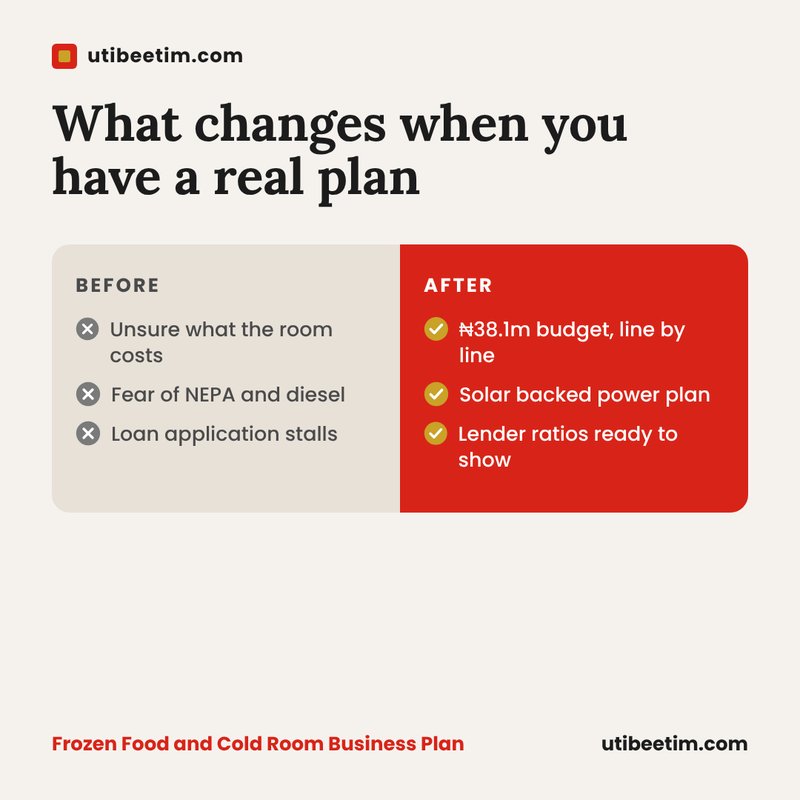
| Before the plan | After the plan |
|---|---|
| “I think a cold room costs about ₦10 million” | A ₦38.1 million budget, line by line, that you can resize to your money |
| Afraid NEPA and diesel will eat the profit | A three-layer power plan with a ₦420,000 monthly budget |
| Selling at whatever price the market sets | Knowing your margin on every kilo and a weekly pricing rule |
| No idea when the business pays for itself | Break-even and a payback period of about 1.6 years, clearly shown |
| The loan officer’s questions go unanswered | Lender-ready ratios, a funding request and a repayment schedule |
What is inside the pack

- Business plan (Word, 48 pages): 11 chapters and 5 appendices, with 13 editable charts, SWOT, risk heat map and implementation timeline. Even the cover is editable.
- 3-year financial model (Excel): built on the SCORE template lenders know, with monthly projections, income statement, cash flow, balance sheet, break-even and stress tests.
- Buyer Customisation Guide (Word, 15 pages): step-by-step instructions to edit every sheet, every chart and every page, written for first-time founders.
- Startup Checklist (Excel): 62 launch tasks with costs that add up to the project budget, a status drop-down and a progress dashboard.
Original price was: ₦32,500.00.₦16,125.00Current price is: ₦16,125.00.Order Now
Who this plan is for

- First-time founders starting a cold room or frozen food shop
- Traders moving from chest freezers to a walk-in cold room
- Fish farmers and poultry farmers adding a sales outlet
- Diaspora Nigerians investing in a cold room at home
- Founders applying for a bank loan, development finance, a grant or investor funding
How to use this plan as your funding roadmap
- Make it yours. Follow the guide to replace the sample company name, founder details, location and photos. It takes an evening.
- Set your real budget. Get two quotes for the cold room and solar, enter your rent and prices, and check that cash never goes negative in the model.
- Choose your funding route. Bank or development loan, investor, grant, or a mix. The plan already contains the funding request, use of funds and repayment schedule each one asks for.
- Answer application questions from the plan. Grant and loan forms ask about the problem, market, competitors, revenue model, team, risks and impact. Each answer is already a section of the plan.
- Prepare for the interview. Know three numbers by heart: total project cost, monthly break-even and debt service cover.
- Launch with the checklist. Once funds arrive, work through the tasks phase by phase.
- Review at 90 days. Compare actual sales, margins and power costs with the model, and adjust early.
Funding programmes and opportunities
Grants, loans, accelerators and competitions for Nigerian businesses open and close all year, including programmes for agribusiness and food businesses. We publish them as they open, with eligibility and how to apply.
See the latest funding opportunities, updated regularly. You can also browse all business grants and business loans, or read our guide to answering Tony Elumelu Foundation programme questions.
When you find one that fits, your plan already holds most of the answers the application will ask for.
Want a plan built around your exact cold room?
The readymade plan fits most cold room and frozen food businesses and scales to your budget. But if you have a specific site, an existing business, partners, a larger cold storage or distribution project, or a funder with its own template, we will write a custom plan for you: your location, your numbers, your story and your funding target.
Our custom plans start with a questionnaire, then research on your market and site, then a fully tailored plan and financial model with revisions until it is right.
See our custom business plan services or call or WhatsApp 0703 154 2324.
You can also browse custom-made business plans or get the 4-in-1 essential documents bundle.
Related business plans
Building along the food and protein supply chain? These plans pair well with a cold room:
-
Standard Business Plans
Barbecue Business Plan with 3 Years Financial Projections
Original price was: ₦32,250.00.₦16,125.00Current price is: ₦16,125.00. Order Now -
Business Plans
Catfish Business Plan With 3 Years Financial Projections
Original price was: ₦32,500.00.₦16,125.00Current price is: ₦16,125.00. Order Now -
Poultry Farming Business
Poultry Business Plan With 3 Years Financial Projections
Original price was: ₦32,500.00.₦16,125.00Current price is: ₦16,125.00. Order Now -
Business Plans
Supermarket Business Plan with 3 Years Financial Projections
Original price was: ₦32,500.00.₦16,192.00Current price is: ₦16,192.00. Order Now


See all readymade business plans across 130+ industries, the best-selling business plans in Nigeria, or visit the full store.
Start with the numbers
A cold room is not won by buying the biggest freezer. It is won by keeping stock frozen at a sensible power cost, buying close to source, selling by the kilo and repricing every week.
Get the numbers right on paper first. Then go and build the cold room.
Original price was: ₦32,500.00.₦16,125.00Current price is: ₦16,125.00.Order Now
View the full Frozen Food and Cold Room Business Plan
Sources: NBS CPI, September 2026; The Sun, July 2026; Ecofin Agency, September 2026; Nairametrics Lagos market price surveys, June to September 2026; Vanguard, March 2026; PVPro, 2026; Prioni, May 2026; IKEDC tariffs, 2026; Nigeria Tax Act 2025. Startup costs are Lagos dealer and installer estimates for October 2026 used in our financial model.