
If you want to start a layer farm, a layers poultry business plan in Nigeria has to answer one hard question before any other: where will the money for your next batch of birds come from? Many farms that shut down between 2025 and 2026 still had buyers for their eggs. What they didn’t have was the cash to restock when their birds stopped laying.
This guide walks you through what a 2,000-bird layer farm really costs in 2026, how it makes money from eggs, old layers and manure, the licences you need, the risks that matter, and how to put it all into a plan a bank will take seriously. Every figure comes from a fully costed 3-year model for a farm in Obafemi Owode, Ogun State.
The egg market in Nigeria in 2026
Nigeria produced about 658,000 tonnes of eggs in 2024, slightly below a 2023 high of about 671,000 tonnes, according to Our World in Data, from FAO figures. Output has been flat for about ten years while the population kept growing.
2026 has been a hard year for supply. Day-old pullet chicks rose from about ₦1,800 in January to ₦3,000 within three months, as BusinessDay reported. Many farmers who sold their old layers couldn’t restock. Farm-gate egg prices rose from about ₦5,000 a crate in January to about ₦5,500 in March, and some Lagos outlets sold a crate for ₦8,500 (Nairametrics, March 2026). By October, medium eggs had eased to about ₦5,400 in Lagos as feed got cheaper after the harvest.
For a well-planned new farm, that’s an opening. Distributors, bakeries and eateries want a supplier who has eggs every day. A farm that plans its restocking from day one can win those buyers and keep them.
How much does it cost to start a layer farm?
Here is the startup budget for a 2,000-bird battery-cage farm on a leased two-plot site with an existing animal shed. Prices are Ogun and Lagos prices from late 2026.
| Item | Amount |
|---|---|
| 17 battery cages (120 birds each), water system, generator and tools | ₦9,050,000 |
| Pen conversion, egg store and feed store | ₦1,500,000 |
| Furniture, phone, records app, lights and CCTV | ₦500,000 |
| First batch: 1,000 point-of-lay pullets at ₦9,300 | ₦9,300,000 |
| Lease fees, legal, permits, insurance, supplies, launch marketing | ₦1,570,000 |
| Working capital, including the second batch of 1,000 pullets | ₦14,700,000 |
| Total project cost | ₦36,620,000 |
Notice that about half the money goes on birds. That’s normal for layers. You’re buying 2,000 point-of-lay pullets at 16 to 18 weeks old, so you start selling eggs within weeks instead of rearing chicks for five months.
Starting smaller? You can start with one batch of 1,000 birds, but keep the logic the same: lease rather than buy land, mix your own feed, hire delivery per trip, and keep the cash for your next restock in the bank. Profit on 1,000 birds is thin, so plan to grow to 2,000 as soon as you can.
How a layer farm makes money
A layer farm has three income streams. Each one works on a different timetable.
1. Table eggs: daily cash
Eggs are about 88% of revenue. A well-managed brown layer peaks at about 89% hen-day production in its fourth and fifth months in lay, then declines slowly. Over 14 months, one bird placed gives about 297 saleable eggs, or about 10 crates.
On a 2,000-bird farm that’s about 46 crates a day from Year 2. Most go to distributors and market women at the farm gate. The rest go direct to bakeries, eateries and shops at a delivered price.
2. Old layers: income at the right time, not straight away
This is where many new farmers go wrong. Old-layer (spent hen) income can’t start immediately. A batch that arrives in January still lays well until the following February. Sell it early and you throw away months of profitable eggs.
In our model the first old-layer sale happens in Month 14, and Year 1 has no old-layer income at all. Decide when to sell with three tests:
- Laying rate: once the batch lays below about 70% for several weeks, the eggs no longer cover the feed by a safe margin.
- Calendar: live-bird prices rise before Christmas, Easter and Sallah, so move a sale date to meet a festive peak where you can.
- Restock: book your next batch two to three months ahead, so the cages are full again within about a month.
Old layers sold for about ₦5,000 to ₦7,000 a bird live in 2026, and much more at festive retail.
3. Poultry manure: waste that pays
Cage manure is dry and clean. A thousand birds give about 25 bags of 50kg a month, which vegetable and pepper farmers buy at about ₦1,000 a bag. It’s less than 1% of revenue, but it keeps the farm clean and your neighbours on side.
Why two batches beat one
If you buy all your birds at once, you’ll sell them all at once, and your farm will be empty for a month. Your distributors will find another supplier. Two batches placed three months apart mean one batch is always laying while the other is being sold and replaced.
The numbers: what the model shows
| Year 1 | Year 2 | Year 3 | |
|---|---|---|---|
| Revenue | ₦79.3m | ₦99.8m | ₦98.7m |
| Net profit | ₦5.6m | ₦7.1m | ₦5.9m |
| Debt service cover | 1.75x | 1.86x | 1.55x |
These numbers hold egg and feed prices flat for three years. As a new livestock company, the farm pays no income tax in its first five years under the Nigeria Tax Act 2025.
The most useful single number is the break-even egg price. One crate costs about ₦2,944 in feed and about ₦3,525 once the pullet, vaccines and trays are added and the old-layer sale is credited back. Once you add staff, lease, power, depreciation and loan interest, the farm breaks even at about ₦4,780 a crate in Year 2.
Licences and regulation
- CAC: register as a private limited company. You need a company to qualify for the five-year agricultural tax holiday.
- State agriculture ministry: register the farm (for example, with the Ogun State Ministry of Agriculture and Food Security).
- Poultry Association of Nigeria: join your state chapter for price updates and group buying.
- Veterinary: use a vet registered with the Veterinary Council of Nigeria, and report notifiable diseases such as bird flu to the state veterinary services.
- NAFDAC: shell eggs don’t need product registration, but you should only use NAFDAC-registered feeds, vaccines and drugs.
- Employer duties: pension, NSITF, ITF and PAYE for your staff.
The risks, and how to manage them
Layer farming has thin margins. Here’s what the stress tests in our model show:
- Egg price down 10%, feed unchanged: the farm makes a loss. Protect yourself by selling more direct to businesses and building loyal distributors.
- Feed up 15%, egg price unchanged: the farm also makes a loss. Buy maize in bulk at harvest and custom-mix layer concentrate with maize and wheat offal. That saves about 9% against complete layer mash.
- Egg and feed prices both down 10%: the farm stays profitable, because maize drives both prices.
- Laying 10% below plan (disease or heat): this causes a loss, so biosecurity comes first. Use one gate, foot dips and vaccines on schedule, and keep buyers out of the pens.
- Pullets 20% dearer: the farm stays profitable, because each bird lays for 14 months and is sold at the end.
How to write your layers poultry business plan
A bank or lender will want to see:
- A clear farm model: number of birds, batches and housing.
- A monthly revenue build from the flock: laying curve, mortality and prices.
- A startup budget with dealer quotes.
- Three years of income statement, cash flow and balance sheet.
- Debt service cover, break-even and a sensitivity analysis.
- Your restock plan and old-layer timing.
- A funding request with security and repayment.
You can build all of that yourself in a spreadsheet, or you can start from a plan that has already done the research and the maths.
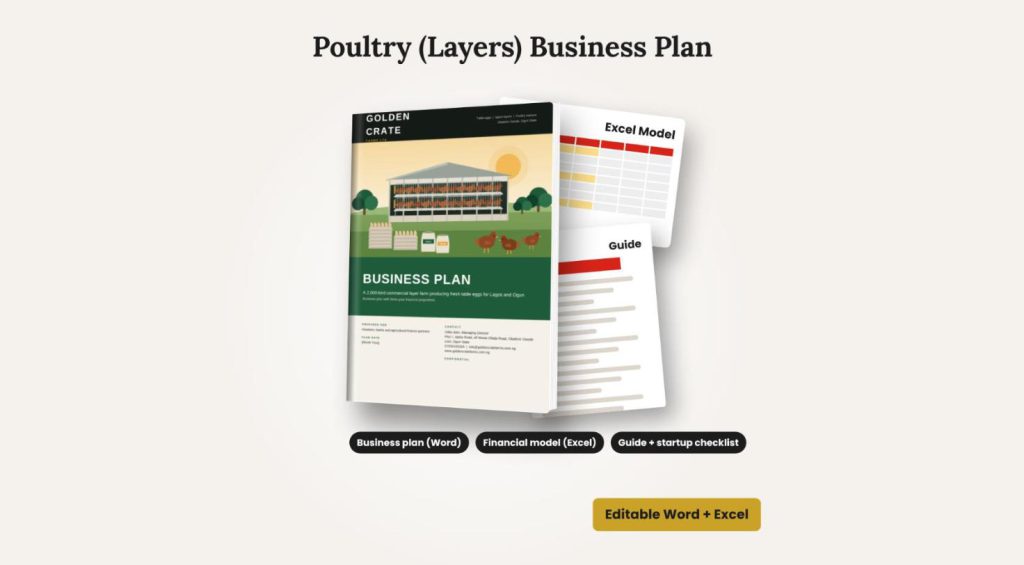
Get the Poultry (Layers) Business Plan. You get a 48-page bank-ready plan in Word with 12 editable charts, a 3-year Excel model built from a monthly flock calendar, a step-by-step buyer guide, and a 52-task startup checklist. Built on 2026 Ogun prices and the Nigeria Tax Act 2025.
₦16,125 (was ₦32,500). Get the layers business plan
Prefer a plan written around your own farm? See our custom business plan services, or browse more than 130 readymade plans, including feed mill and integrated poultry and fish farming.
Frequently asked questions
How much do I need to start 2,000 layers in Nigeria?
About ₦36.6 million in Ogun State in 2026, on a leased farm with battery cages. That includes two batches of point-of-lay pullets and working capital. About half of it is the cost of the birds.
When can I start selling old layers?
Not in your first year. Each batch lays for about 14 months, so the first old-layer sale comes in about Month 14. Sell when laying falls below about 70%, and time it to festive demand if you can.
How many crates of eggs will 2,000 layers produce?
About 46 crates a day on average once the farm is fully stocked, with peaks of about 55 crates a day when both batches are in full lay.
Is layer farming profitable in Nigeria?
Yes, if you control feed cost and laying performance. Our model shows a net margin of about 6% to 7% on 2026 prices. The margin is thin, so know your break-even egg price.
Do layer farms pay tax?
Under the Nigeria Tax Act 2025, a new company in livestock production is exempt from income tax for its first five years. You still pay PAYE for your staff.
Should I buy day-old chicks or point-of-lay birds?
Point-of-lay birds cost more per bird, but you skip about 17 weeks of rearing feed and risk, and you start selling eggs within weeks. For a first commercial farm, point-of-lay is usually the safer start.
Start with the numbers
A layer farm is a simple business that punishes poor planning. Plan your batches, your feed and your restock cash before you buy a single bird. Get the Poultry (Layers) Business Plan, or WhatsApp 0703 154 2324 if you want us to build a plan for your own farm.