
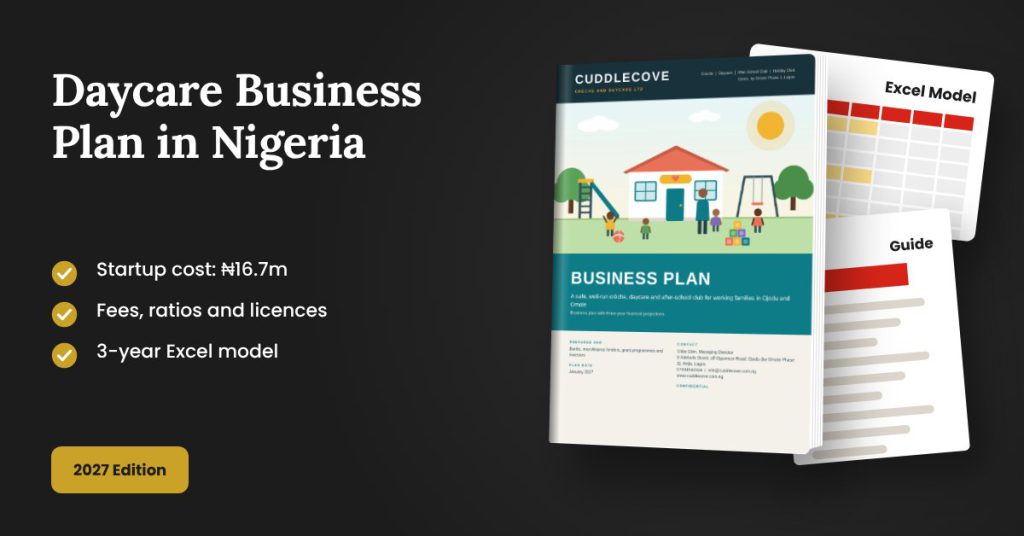
Every working mother in Lagos knows the 7am problem. You have to leave home before traffic builds, the nursery down the road opens at 8am, and the school closes at 1pm. Somebody has to fill those hours. That is why a well-run crèche is one of the most dependable small businesses you can start in Nigeria today. This guide walks you through a daycare business plan in Nigeria for 2027: what it costs, how it makes money, the licences you need, the risks, and how to put it all into a plan a bank or grant panel will take seriously.
The figures below come from our newly rebuilt Daycare Business Plan, modelled on a lean, rented centre in Ojodu, beside Omole Phase 1, Lagos, with current 2026 fees, rents and salaries.
Why daycare is a strong business in Nigeria right now
Demand is large and under-served. According to the Universal Basic Education Commission, citing the 2021 Multiple Indicator Cluster Survey, only 35.6% of Nigerian children aged 36 to 59 months attend any form of early childhood care and education. That leaves about 10 million young children outside the system (Arise News).
Employers have not filled the gap either. A 2023 report by the IFC and the Nigerian Exchange Group, Investing in Childcare, found that only 5% of private employers in Nigeria offer any childcare support, even though most working parents surveyed said reliable childcare would make them more productive (Nairametrics).
Put those together with long Lagos commutes, fewer grandparents nearby and growing fear of unvetted nannies, and you get a simple truth: parents in estates like Omole, Magodo, Gbagada and Ikeja are not asking whether to pay for childcare. They are asking which centre they can trust.
Who your customers are
- Returning mothers who go back to work after three to six months of maternity leave and need an infant crèche.
- Dual-income families with a toddler between 18 months and 4 years who need a full working day of care.
- School-age families whose nursery or primary school closes by 2pm. This is your after-school club, for children aged 2 and upward.
- Occasional users who need a drop-in day when the nanny travels or a school closes.
- Employers such as schools, hospitals, churches and offices that want reserved places for their staff.
How much does it cost to start a daycare in Lagos?
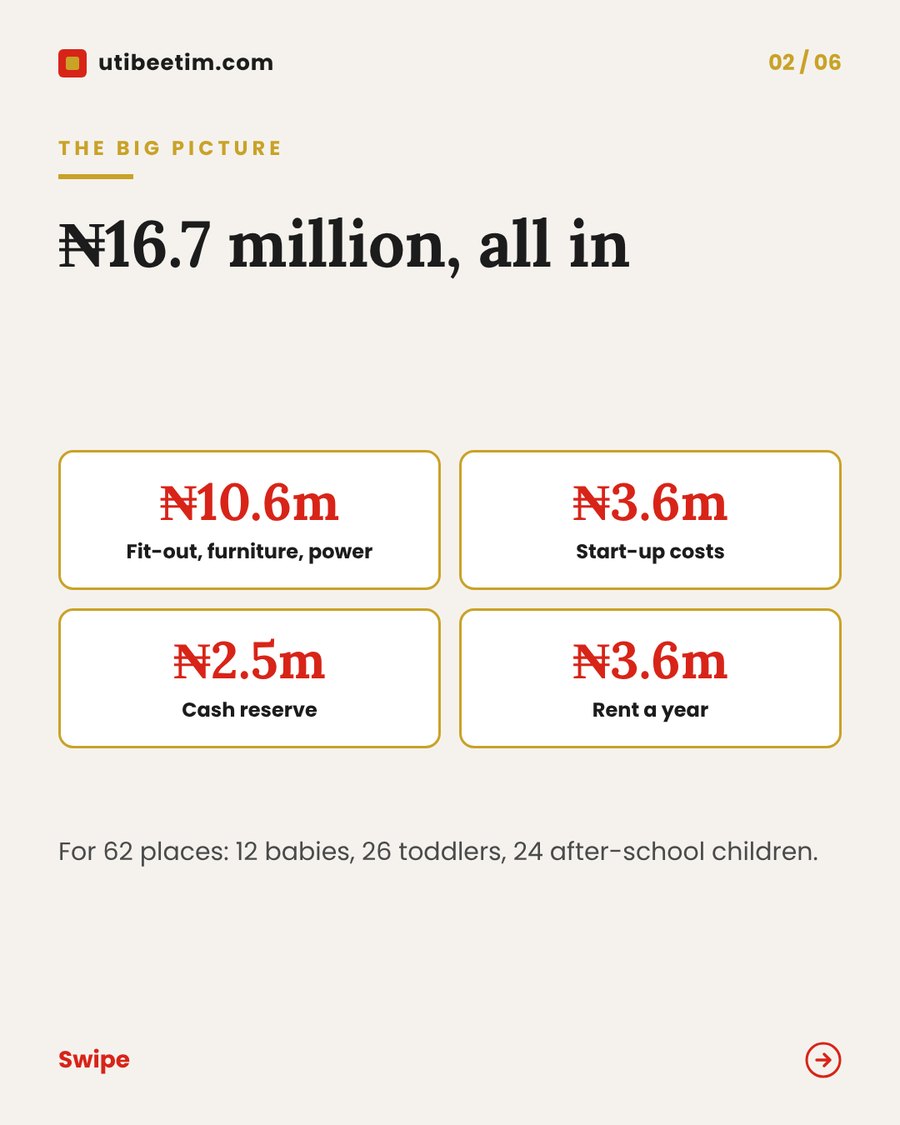
Our model prices a lean, rented centre with 62 places: 12 infant cots, 26 toddler places and 24 after-school places, in a converted three-bedroom bungalow rented at about ₦3.6 million a year. The total project cost is ₦16.7 million.
| Item | Amount (₦) |
|---|---|
| Solar backup (5kVA with lithium battery), CCTV with parent app, IT and fire safety | 3,500,000 |
| Play, learning, kitchen, laundry and cooling equipment | 3,100,000 |
| Cots, nap beds, child-size tables, high chairs and storage | 2,325,000 |
| Childproofing, child toilets and outdoor safety works | 1,700,000 |
| Start-up costs (lease fees, registration, inspections, launch marketing, training, software) | 3,550,000 |
| Working capital reserve | 2,500,000 |
| Total project cost | 16,675,000 |
Two lessons sit inside that table. First, power is your biggest single item. Fans, the baby room air conditioner, the milk fridge and CCTV must run all day, so a solar backup is now standard for any quality centre. Second, the cash reserve is not optional. Rooms fill gradually, and the reserve pays staff and rent while enrolment builds.
If your budget is smaller, you can start with fewer places in a smaller flat and add rooms later. The Excel model in our plan lets you change the number of places, the rent and the equipment list and see the new budget immediately.
How a daycare makes money
A crèche earns recurring monthly fees, paid in advance. That is what makes it attractive to lenders. Our plan builds revenue from six lines:
- Infant crèche (3 to 18 months): ₦95,000 a month, with one caregiver for every four babies.
- Toddler daycare (18 months to 4 years): ₦80,000 a month for a full day from 7.30am to 6.30pm.
- After-school club (2 years upward): ₦50,000 a month, 12.30pm to 6.30pm, with a snack, rest and homework support.
- Holiday club and drop-in days: ₦8,000 a day during school breaks.
- Meals and snacks plan: ₦25,000 a month, optional.
- Admission and learning-resource pack: ₦30,000 once per new child.
These fees sit in the middle of the local market. Typical Lagos daycare fees run from about ₦20,000 to ₦80,000 a month, higher in premium areas (Mypricespot, 2026). Established schools with crèche sections around Omole charge ₦151,000 to ₦300,000 a term for shorter school-day hours (Schools Compass).
On those fees and a careful occupancy ramp, the model shows revenue of ₦36.0 million in Year 1, rising to ₦55.0 million in Year 3. Net income is ₦1.9 million in Year 1, when depreciation, start-up costs and loan interest are highest, then ₦9.3 million in Year 2 and ₦11.9 million in Year 3. Debt service is covered 2.8 times in Year 1, the monthly break-even point is passed in month five, and the whole project pays back in about 1.8 years.
The occupancy rule that keeps you honest
Never plan to fill every place. Children move up rooms, start primary school and relocate. Our plan caps average occupancy at 85% and starts at about one third of places in the first month, filled by open days held before opening. Fees are held flat for three years, so every naira of growth comes from enrolment, not price rises.
Keep staff costs lean
Staff are your largest cost, and the most common way new centres lose money is by hiring a full team before the rooms fill. Start with a small salaried core, for example a Centre Manager, an Early Years Teacher and three caregivers, then add caregivers per shift as each room fills. That way your ratios are always met and your costs follow your enrolment.
Licences and regulations for a daycare in Lagos
- CAC registration as a private limited company under CAMA 2020.
- Day care centre registration and inspection with the Lagos State Ministry of Youth and Social Development, which supervises day care centres in the state.
- Caregiver training through the state’s caregiver training programme, plus paediatric first aid for all care staff.
- Business premises permit from the Lagos State Government and a fire safety certificate from the Lagos State Fire and Rescue Service.
- Police character checks and medical tests for every member of staff, and food handler certificates for the cook.
- Data protection for children’s records, photos and CCTV under the Nigeria Data Protection Act 2023.
- Tax: under the Nigeria Tax Act 2025, a company with turnover below ₦100 million and fixed assets below ₦250 million pays no company income tax.
Always confirm current requirements and fees with the ministry before you sign a lease. Also get the landlord’s written consent to run a day care centre in the building.
The biggest risks, and how to manage them
- A safety incident. This is the risk that can close a crèche overnight. Low ratios, checked staff, CCTV, a strict collection policy and public liability insurance are your protection.
- Slow enrolment. Run open days before you open, reward referrals, sign employer partnerships and keep a cash reserve. In our stress test, enrolment 20% below plan turns Year 1 into a small loss, but the centre returns to profit in Year 2 with no extra borrowing.
- Losing key staff. Pay fairly, train well and reward good parent feedback. Children need familiar faces.
- Late fees. Bill monthly in advance, agree a clear late-payment rule at admission and keep to it.
- Rising costs. Buy food and supplies in bulk, use solar to cut diesel, and review fees once a year with notice.
How to write your daycare business plan
A lender or grant panel will look for the same things every time: a clear service and fee structure, real local competitors, a staffing plan with ratios, a full startup budget, three years of monthly projections, a break-even point, debt service cover and a risk plan. Writing that from scratch, and building the financial model, can take weeks.
You can take the shortcut. Our Daycare Business Plan is a complete, editable pack built on current Lagos figures:
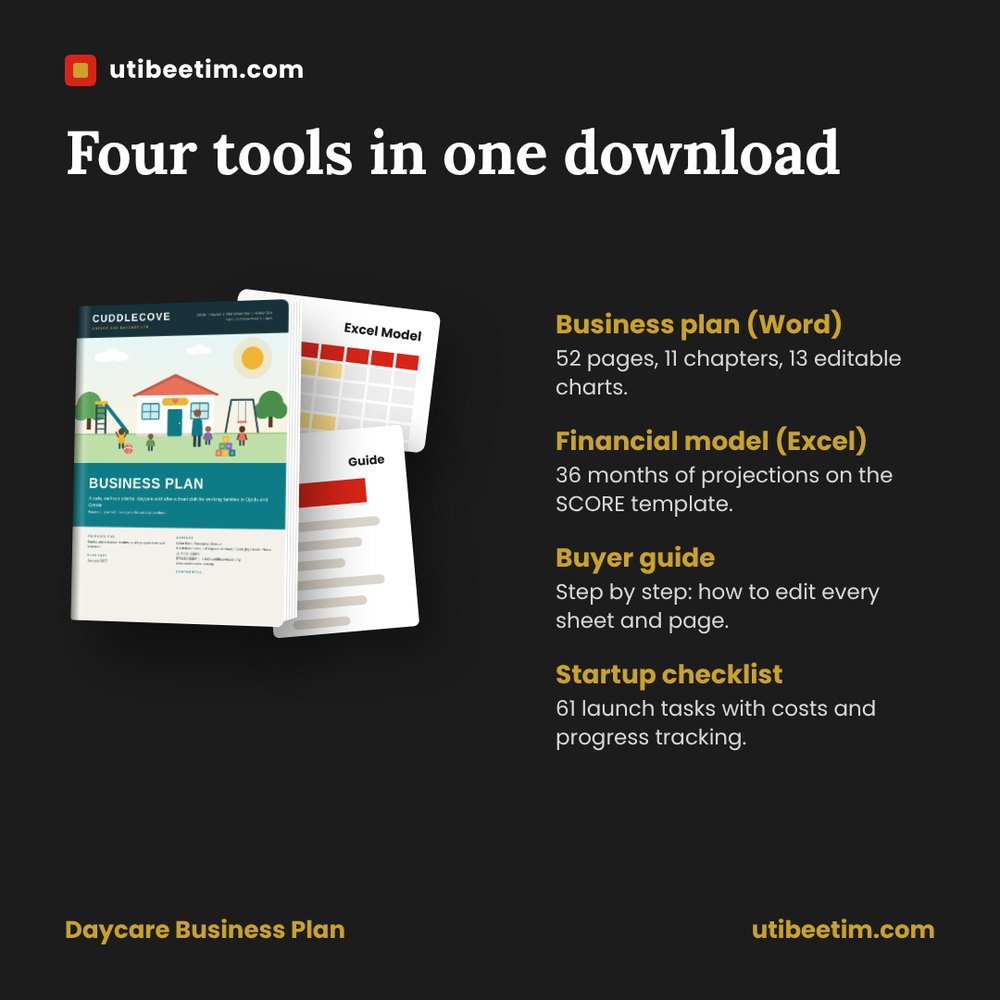
- A 52-page, bank-ready business plan in Word with 13 editable charts.
- A 3-year financial model in Excel with 36 months of projections, built on the SCORE template.
- A buyer customisation guide that shows you, step by step, how to change the fees, places, rent, staff and funding to match your own centre.
- A startup checklist with 61 launch tasks, costs and a progress tracker.
Price: ₦16,125 (was ₦32,500), instant download after payment.
Get the Daycare Business Plan now
Need a plan written specifically for your own centre, location and funding target? See our custom business plan packages, or browse more than 130 readymade business plans in other niches.
Frequently asked questions
How much do I need to start a daycare in Lagos?
A lean, rented centre with about 60 places costs around ₦16.7 million in 2027, including fit-out, furniture, solar backup, start-up costs and a cash reserve. A smaller home-style crèche can start for much less, with fewer places.
How much should I charge for daycare in Lagos?
Most Lagos daycares charge between ₦20,000 and ₦80,000 a month, with higher fees in premium areas. A mid-market centre in an area like Ojodu or Omole can charge about ₦80,000 for toddlers and ₦95,000 for babies, because infants need more staff per child.
Is a daycare business profitable in Nigeria?
Yes, when it is run lean and fills steadily. Our model shows a profit in Year 1 and net income of ₦11.9 million by Year 3, with fees held flat. Profit depends mostly on how fast you fill places, so marketing and parent trust matter more than anything else.
Who regulates daycare centres in Lagos?
The Lagos State Ministry of Youth and Social Development supervises day care centres. You also need CAC registration, a business premises permit and a fire safety certificate.
What is the right caregiver to child ratio?
A good standard is one caregiver for every four babies, one for every six toddlers and one for every ten children in an after-school club. Parents notice ratios on their first visit.
Can I edit the readymade daycare business plan?
Yes. The plan is in Word and the financial model is in Excel. The buyer guide shows you how to change every input, update the charts and replace the sample company details with your own.
Start your crèche with confidence
A daycare is a business built on trust, routines and steady monthly fees. Plan it properly from day one: know your budget, your fees, your staff and your break-even month before you sign a lease. Download the Daycare Business Plan today, or call or WhatsApp 0703 154 2324 if you want us to personalise it for you.