
If you are putting together a pepper farming business plan in Nigeria, you already know the hard part is not the farming. It is the numbers. Banks, grant panels and investors do not want enthusiasm about pepper. They want a plan that shows what it costs to start, how the money comes back, and what happens when the market does not cooperate.
This guide walks through what a serious pepper farming business plan in Nigeria should cover in 2025/2026: the real market picture, what it actually costs to set up a commercial pepper farm, how the business makes money across two seasons instead of one, the licences and regulation you need to know about, the risks that actually sink pepper farms, and how to write or get a plan that holds up under questioning. At the end, you will find our readymade Pepper Farming Business Plan, a complete pack you can edit and submit, if you want the shortcut.
Why Pepper Farming Still Makes Sense In 2026/2027
Nigeria is Africa’s largest pepper producer, growing an estimated 757,000 to 770,000 metric tonnes a year on about 104,000 hectares of farmland, with average national yields of 7 to 8 tonnes per hectare (HortiDaily, 2026). That is a serious volume of production.
And yet Nigeria still ran a net pepper trade deficit of roughly ₦10.1 billion in 2023, importing more pepper value than it exported (BusinessDay, May 2025). Read that twice. A country that grows this much pepper is still a net importer of pepper value. That is not a demand problem and it is not a land problem. It is a consistent supply problem: too much of the national crop is rain fed, handled poorly after harvest, or both.
That gap is exactly where a small, well run, irrigated commercial pepper farm fits. You do not need thousands of hectares to matter in this market. You need two things most smallholder growers do not have: water in the dry season, and discipline after harvest. Bell Pepper and Habanero (locally called atarodo or rodo) are commercially distinct products. Bell Pepper sells mainly into fresh retail, supermarkets and food service, with yields of 9 to 15 tonnes per hectare (NAERLS Bulletin 240). Habanero is a smaller, hotter fruit sold mostly through open markets and food processing, with a large, price resilient local cuisine market behind it. Both carry real seasonal pricing: wet to dry season pepper price swings of up to 150% in Nigerian markets (BusinessDay, May 2025).
The Federal University of Agriculture, Abeokuta, started large scale commercial cultivation of both Habanero and Bell Pepper in 2024 (Guardian; funaab.edu.ng, 2024). When a federal agricultural university puts real land behind a crop combination, that is a strong signal the crop choice itself is sound, not just a social media trend.
What It Costs To Start A Pepper Farm
Our sample plan models a two hectare irrigated farm in Ogun State, one hectare Bell Pepper and one hectare Habanero, with a borehole and drip irrigation system turning one rain fed harvest a year into two. Here is how the 2025/2026 budget breaks down.
| Item | Amount (₦) |
|---|---|
| Borehole, drip irrigation and farm equipment | 5,815,000 |
| Land clearing, fencing, nursery structure and farm store | 3,050,000 |
| Furniture and office setup | 350,000 |
| Other fixed assets | 1,250,000 |
| Opening working capital (wages, inputs, licences and cash reserve to first harvest) | 8,250,000 |
| Total project cost | 18,715,000 |
Starting smaller? You do not need two hectares and a borehole on day one. Many buyers of this plan start with one hectare, rain fed, and add the irrigation line once the first harvest proves the market. Every cost line in this plan can be adjusted up or down to match your own budget and land size.
How A Pepper Farm Actually Makes Money
Two crops, not one bet. Bell Pepper and Habanero do not peak at the same time, and they do not sell to the same buyer. Running both means the farm has income from at least two directions, so a bad week for one crop does not wipe out the month.
Irrigation changes the calendar. A borehole and drip lines mean the farm is not waiting on rain to plant. Two harvest cycles a year instead of one is the single biggest driver of the revenue in this plan, and it is also why the opening budget is higher than a rain fed plot.
Postharvest discipline protects the price. Pepper loses value fast once it is off the plant. The plan budgets for crates, shade handling and same week delivery to market, because a farmer who dumps produce in open sun is cutting their own price before any buyer does.
Channel mix spreads the risk. Selling only to one Mile 12 aggregator means that aggregator sets your price. This plan spreads sales across wholesale markets, processors and direct supply to small shops and eateries, so no single buyer controls the farm’s income.
See the full Pepper Farming Business Plan
What The Numbers Look Like Over Three Years
Revenue holds steady at about 36,540,000 Naira a year across the three year projection, since the farm runs the same two hectares at the same intensity each year. What changes is the margin. Net income comes to about 9,750,000 Naira in year one, 8,760,000 Naira in year two and 7,800,000 Naira in year three, as input costs and labour creep up with inflation.
The debt service coverage ratio starts at 5.08x in year one and settles at 4.17x by year three, well above the 1.25x that most banks ask for. Even in a stressed scenario, with lower yields and higher costs, the plan still holds a DSCR of 1.39x. That is the kind of cushion a loan officer wants to see.
Payback on the full 18,715,000 Naira project cost comes in at about 1 year and 3 months. Breakeven revenue in year one is roughly 23,760,000 Naira, well under the 36,540,000 Naira the farm is projected to bring in, which means there is real room for the numbers to come in lower than planned and the business still works.
Licences, Permits And Regulation
You do not need a mountain of paperwork to start, but a few registrations protect you and open doors later.
- CAC registration. Register the business with the Corporate Affairs Commission, as a business name or a limited company, before you approach any bank or grant panel.
- State Ministry of Agriculture registration. Most states ask commercial farms to register, which also opens the door to extension services and subsidised inputs.
- ADP enrolment. Signing up with your state’s Agricultural Development Programme gives access to training, improved seedlings and sometimes input support.
- NAFDAC compliance. If you process or package pepper products for sale, NAFDAC registration applies, and sourcing from listed suppliers protects your certification.
- NAQS registration. If you plan to export fresh or dried pepper, the Nigeria Agricultural Quarantine Service has to certify the produce first.
The Biggest Risks, And How To Manage Them
Every pepper farm faces the same handful of risks. Here is how this plan handles each one.
- Irrigation uptime. A borehole pump failure in dry season can wipe out a harvest. The plan budgets for a backup generator and a maintenance contract with the equipment supplier.
- Price volatility. Pepper prices can swing by more than a hundred percent between peak and lean season. Spreading sales across two harvest windows and multiple buyers softens the swings.
- Postharvest loss. Pepper can lose a third of its value within days of harvest if handled badly. Crates, shade and a same week delivery plan protect the money already spent getting the crop out of the ground.
How To Write Your Pepper Farming Business Plan
If you are writing this yourself, here is the structure that holds up when a bank or grant panel actually reads it end to end.
- Executive Summary
- Business Description
- Products and Services
- Market and Industry Analysis
- Marketing and Sales Strategy
- Operations Plan
- Management Structure
- Financial Projections
- Risk Analysis
- Funding Requirements
- Implementation Timeline
Writing it yourself can take a few weekends of real work. Buying this plan means you get all eleven sections done, with the numbers already built, tested and ready to submit. You are not starting from a blank page.
Get The Readymade Pepper Farming Business Plan

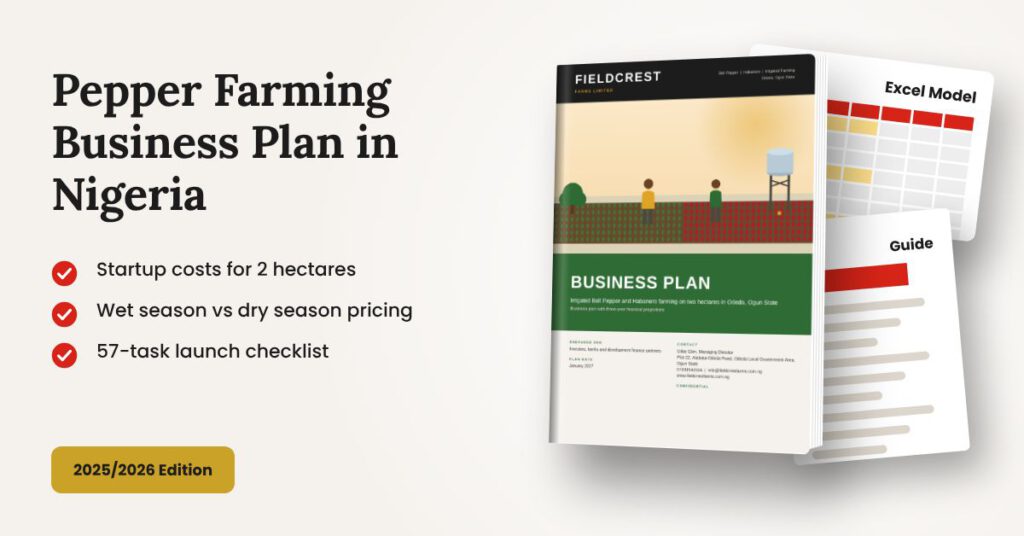
This is a complete pack built for Nigerian banks, cooperatives and grant panels. Every figure sits on a working financial model, not a guess, and every section is fully editable in Word and Excel. Here is what you get.
- The full business plan in Word, structured across all eleven sections and ready to edit or submit
- The three year financial workbook in Excel, built on the same figures as this article
- A startup checklist in Excel, every launch task costed and ready to track
- A buyer customisation guide in PDF, walking you through how to adapt every page to your own farm
Remember, every figure in this plan can be increased or reduced to match your own budget. If two hectares with a borehole is too big a first step, start with one hectare rain fed and scale up once the first harvest sells.
Prefer A Plan Written For Your Own Farm?
Maybe your farm is bigger than two hectares, or smaller, or you are growing something other than pepper on the same land. If this readymade plan does not fit your numbers exactly, we write one from scratch for your specific business. We have done over 1,200 custom plans since 2012, for farmers, processors and small business owners across Nigeria who needed a plan that matched their real figures. Message us on WhatsApp at 07031542324, or see our business plan services to get started.
Frequently Asked Questions
How much do I need to start a pepper farm in Nigeria?
This plan is built on a full two hectare setup with a borehole and drip irrigation, coming to 18,715,000 Naira in total project cost. If that is too much for a first step, start with one hectare and rain fed irrigation. You will spend far less, and you can add the borehole once the first harvest sells.
Is pepper farming profitable in Nigeria?
Yes, if you run it with irrigation and sell across more than one channel. This plan projects net income of about 9,750,000 Naira in year one, with the debt service coverage ratio starting at 5.08x, which is well above what most banks ask for. Pepper is not a guaranteed business, but the numbers in this plan hold up even in a stressed scenario.
Can I use this plan to get a bank loan or grant?
Yes. The plan is structured the way banks, cooperatives and grant panels expect, with a cost breakdown, revenue build, debt service coverage ratio, payback period and breakeven analysis already worked out. You still need to update the sample details, such as the founder profile and company name, to your own before you submit it anywhere.
Can I change the figures in this business plan?
Yes. Every figure in the business plan and the financial workbook is fully editable, not locked. You can change the land size, the equipment list, the prices, the staff count or any cost line, and the workbook recalculates the revenue, profit and funding numbers to match.
How long before a pepper farm starts earning?
With irrigation, this plan runs two harvest cycles a year, so your first cash from pepper sales can come within a few months of planting. Based on the full financial model, payback on the total project cost comes in at about 1 year and 3 months, and breakeven revenue in year one sits well below what the farm is projected to earn.
Get The Pepper Farming Business Plan Now
Looking for something related? See our full list of readymade business plans.