
Every school term in Lagos, parents queue at crowded market stalls to buy school lists. Then they walk to a business centre to print and bind documents. Office managers send staff to Idumota for paper and toner. The demand is large and it comes back every term. Good service is hard to find.
That gap is why a stationery business plan in Nigeria is worth getting right. Stationery is a needs-driven business, but the margins are thin. Buy stock badly, overpay rent or hire too many people, and the shop ends up working for the landlord. This guide shows what it really costs to start, how a stationery store makes money, the licences you need and the mistakes to avoid. It uses figures from our new Stationery Business Plan for a shop in Yaba, Lagos.
Get the Stationery Business Plan: ₦16,125
Is a stationery business profitable in Nigeria?
Yes, if you run it as a real retail business and not a hobby. Demand is steady and grows with school enrolment and new businesses. 6Wresearch projects the Nigeria stationery market to grow at 6.2% a year from 2025 to 2031, with paper products taking the largest share. Global Market Insights values the African stationery market at 5.5 billion US dollars in 2025, with offices taking 42% of spending.
Lagos is the biggest market in the country. The 2024/2025 Annual School Census recorded 2,036,042 learners in Lagos State, and 1,170,918 of them were in private schools. Every learner needs exercise books, pens, mathematical sets and art materials every term. On top of that, thousands of offices, churches, clinics and small businesses buy paper, files and toner every month.
The catch is the margin. Most shelf items leave you about a third of the selling price as gross profit. The stores that make money combine stationery with higher-margin services such as printing, binding and bulk supply.
How much does it cost to start a stationery business in Lagos?
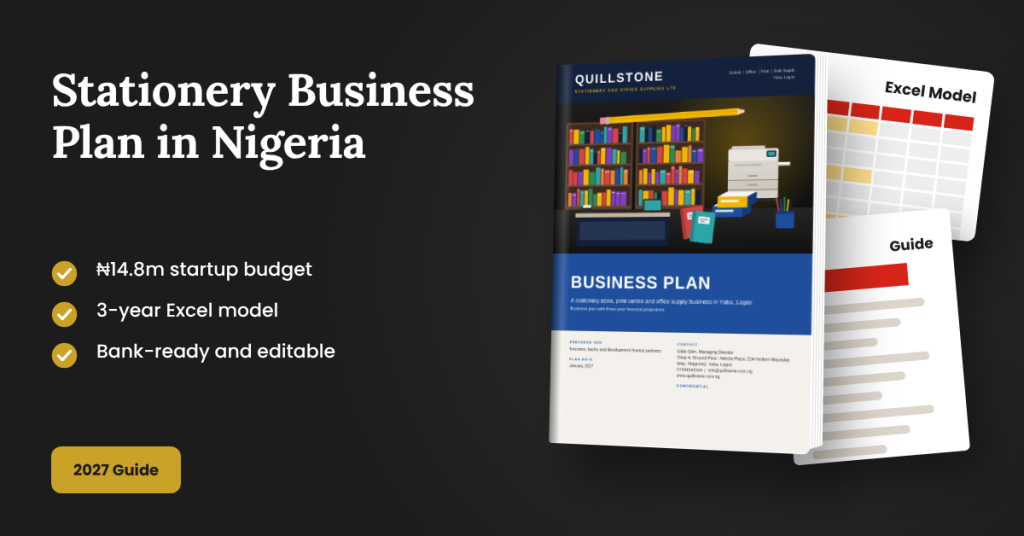
Our plan models a lean, well-stocked shop of about 40 square metres in Yaba, with a print corner and a delivery service for schools and offices. The total startup budget is ₦14.8 million.
| Item | Amount (₦) |
|---|---|
| Refurbished A3 production copier | 1,250,000 |
| Colour ink-tank printer, binding machine, laminator and guillotine | 920,000 |
| Shop fit-out, rewiring and fans | 900,000 |
| Shelving, counter, display case and stockroom racks | 1,350,000 |
| Solar for till and lights, generator for the copier | 1,420,000 |
| POS system and CCTV | 900,000 |
| Opening stock (about 800 product lines) | 2,500,000 |
| Legal, permits, launch marketing, supplies, website and utilities | 1,500,000 |
| Working capital (pre-opening salaries, lease fees, caution and ramp-up cushion) | 4,060,000 |
| Total | 14,800,000 |
The plan funds this with ₦8 million from the founder, ₦3 million from a minority investor and a ₦3.8 million loan over 36 months.
Can you start smaller?
Yes. You can start with a counter, one photocopier and fast-moving school items for a fraction of this budget, or run a home-based supply service for schools and offices first. Every figure in the plan and the Excel model can be increased or reduced to match your own budget.
How a stationery store makes money
Don’t depend on one door. The plan builds revenue from six lines:
- School and student stationery: exercise books, pens, mathematical sets, calculators and school bags. This is the biggest line.
- Office supplies and paper: A4 paper, files, envelopes and toner. Thin margin, but it brings regular buyers.
- Printing, copying and binding: the profit engine, keeping about 65 kobo of every naira.
- Branded exercise books and booklets: designed in-house and printed by partner presses.
- Bulk supply to schools and offices: monthly orders delivered with an invoice.
- Art, craft and gift items: strong in December and at graduation season.
Put together, the model shows sales of ₦66.2 million in Year 1, rising to ₦87.6 million and ₦99.2 million. The blended gross margin is about 35%. Net profit is ₦6.9 million in Year 1, ₦12.4 million in Year 2 and ₦15.0 million in Year 3. The loan is covered 5.3 times in Year 1, and the project pays back in about a year and a half.
Download the plan and Excel model
Licences and regulations you need
- CAC registration as a limited company or business name
- Tax registration with the Nigeria Revenue Service, and PAYE with the Lagos State Internal Revenue Service
- Lagos State business premises permit
- LASAA permit for your shop signage
- Fire safety certificate from the Lagos State Fire and Rescue Service, because you store paper
- A REPRONIG reprographic licence for your print centre. Under the Copyright Act 2022, you must not photocopy whole copyrighted textbooks.
- Safe handling of customer files under the Nigeria Data Protection Act 2023
Under the Nigeria Tax Act 2025, a company with turnover below ₦100 million and fixed assets below ₦250 million pays 0% company income tax. In our model the shop stays under that line for three years.
Five mistakes that kill stationery shops
- Buying stock at retail prices. Buy from importers, manufacturers and Idumota wholesalers. In our stress test, a 15% rise in stock cost wipes out almost all Year 1 profit.
- Running out at resumption. Most school sales happen in two weeks each term. Order three weeks ahead.
- No till and no stock count. Use a POS, reconcile the till daily and count fast movers weekly.
- Credit for everyone. Give schools and offices credit only after three cash orders, with 30-day terms.
- Too much overhead. A team of three, a modest shop and dispatch riders paid per trip keep the shop profitable.
What is inside the Stationery Business Plan
The pack is built for founders who need a plan for a bank, microfinance bank, grant or investor. Here is the table of contents and what each part covers:
- Executive Summary: the business, the opportunity, the ₦14.8m budget, funding and three-year results.
- Company Overview: registration details, ownership, mission, values, keys to success and the shop layout.
- Products and Services: the full range, pricing, print price list, customer journey and copyright compliance.
- Industry Analysis: Nigerian and African market data, drivers, challenges and regulations.
- Market and Competition: customer segments, buying behaviour, real Yaba competitors and a SWOT.
- Marketing and Sales Strategy: pricing, channels, school outreach, loyalty and the marketing budget.
- Operations Plan: daily routine, capacity, equipment, sourcing, stock control and delivery.
- Management and Organisation: organisation chart, team profiles, board and payroll.
- Risk Analysis: risk heat map, register and how each risk is managed.
- Financial Plan: start-up budget, income statement, cash flow, balance sheet, break-even, lender ratios and stress tests.
- Funding and Implementation: the funding request, security, timeline and milestones.
- Appendices: asset schedule, opening stock plan, store checklist and sources.
You get the 48-page plan in Word and PDF, a 3-year Excel financial workbook, a buyer customisation guide and a startup checklist with 56 tasks and costs. Every section, figure and chart can be changed. Move it to Ikeja, Ibadan or Abuja, start bigger or smaller, and the numbers update in the workbook.
Order now: ₦16,125 (was ₦32,500)
Who this plan is for
- Teachers, bookshop staff and business centre owners ready to open their own store
- Founders applying to a bank, microfinance bank, grant programme or investor
- Existing stationery sellers who want to add printing, branded products or bulk supply
- Anyone who wants to see the real numbers before signing a shop lease
Want a plan written for your exact business?
If you are applying for a loan or grant with a deadline, our custom business plan service writes the plan around your own location, budget, team and funding, with a financial model built for your numbers. See the packages at utibeetim.com/business-plan-services, or WhatsApp 0703 154 2324.
Looking at other ideas? Browse our 130+ readymade business plans, including the Printing Press, Supermarket and School business plans.
Frequently asked questions
How much do I need to start a stationery shop in Nigeria?
Our Lagos model comes to ₦14.8 million for a 40 square metre shop with a print corner. A small counter with one photocopier can start for much less.
What is the profit margin on stationery?
School stationery leaves about 33% of the price as gross profit when you buy in bulk, paper about 24%, and print services about 65%. The plan’s blended gross margin is about 35%.
Where is the best place to open a stationery store?
Close to schools, a campus or a cluster of offices, on a road with heavy foot traffic. Yaba, Akoka, Surulere and Ikeja are strong in Lagos.
Do I need a licence to run a photocopy business?
You need your business premises permit and signage permit, and you should hold a REPRONIG reprographic licence. Never copy whole copyrighted textbooks.
Can I use this plan for a bank loan or grant?
Yes. It is built to the standard lenders ask for, with a 3-year model, break-even and debt cover ratios. Replace the sample details with your own before you submit.
A stationery store won’t make you rich overnight. Run lean, buy well and add printing and bulk supply, and it becomes a steady, profitable business that schools and offices depend on. Start with a plan that shows you the numbers before you spend a kobo.