
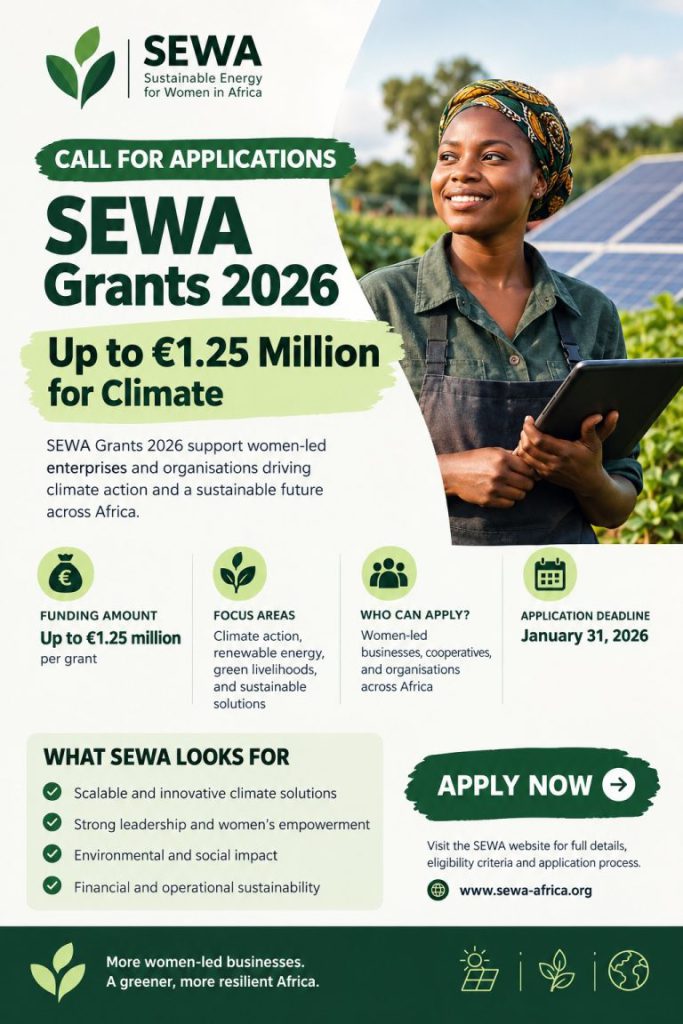
The SEWA Grants 2026 are now open for applications. SEWA stands for Strengthening Early Warning in Africa, and this call is one of the most significant climate funding opportunities currently active on the continent. Four regional grants of up to approximately €1.25 million each are on offer, totalling a €5 million investment pool, to support the development of impact-based forecasting and early warning systems across West, Central, East, and Southern Africa, including the Indian Ocean Islands. The programme is led by the European Centre for Medium-Range Weather Forecasts (ECMWF), in partnership with the African Union Commission and EUMETSAT, and is funded by the European Union under the Global Gateway initiative.
Before going into what the programme offers, the most important thing any potential applicant needs to understand is that the SEWA Grants 2026 are not available to individual organisations applying alone. This is a consortium grant with specific institutional requirements. Understanding the structure upfront will save time and determine whether your organisation can participate as a lead applicant, a consortium partner, or not at all in this cycle.
What the Programme Is Built to Solve
Around one third of the global population currently has no access to adequate multi-hazard early warning systems. In sub-Saharan Africa, where climate-related hazards including floods, droughts, heatwaves, and cyclones affect hundreds of millions of people, the gap between the weather data that exists and the actionable warnings that communities actually receive has long been identified as a critical development failure.
The United Nations Early Warnings for All initiative, known as EW4All, is targeting universal access to weather warnings by 2027. SEWA is ECMWF’s direct contribution to that goal from an African perspective. Rather than building general meteorological infrastructure, SEWA focuses on impact-based forecasting. This means not just predicting that a storm is coming, but combining weather and climate data with exposure, vulnerability, and local impact data to generate warnings that tell communities and decision-makers what the storm is likely to do to them specifically, and what they should do about it before it arrives.
The four regional grants will each fund a two-year pilot that demonstrates this kind of impact-based forecasting in practice, adapted to the specific hazard landscape, data environment, and institutional context of each African region.
The Four Regional Grants
Each grant is tied to one of four African regions, and applications are submitted separately per region. The four calls are for West Africa, Central Africa, East Africa, and Southern Africa including the Indian Ocean Islands. Each selected project can receive up to approximately €1.25 million over approximately 24 months.
Projects funded under the SEWA Grants 2026 are expected to combine weather and climate information with exposure, vulnerability, and local impact data to generate early warnings that help communities and institutions prepare for potential hazards. The pilot tools and services developed must demonstrate real-world usefulness, reaching the level of actionable information that decision-makers, disaster risk managers, and community responders can actually use.
The programme specifically focuses on solutions that make climate information more useful and more actionable, not just more available. There is a meaningful distinction. Enormous amounts of climate data already exist across Africa. What communities consistently lack is the translation of that data into timely, specific, locally contextualised warnings.
The Consortium Requirement
This is the structural detail that determines whether your organisation can apply, and it is more specific than most grant programmes require.
Each proposal must be submitted by a qualifying consortium. That consortium must include three mandatory members. First, the African WMO Regional Climate Centre that is relevant to the region being addressed, which means AGRHYMET for West Africa, CAPC-AC for Central Africa, ICPAC for East Africa, or SADC-CSC for Southern Africa and the Indian Ocean Islands. Second, ACMAD, the African Centre of Meteorological Applications for Development, is a mandatory consortium member for all four regional calls. Third, at least one European legal entity must be included in every consortium.
National Meteorological and Hydrological Services from the relevant African region should also be incorporated into the consortium where appropriate, and the call documentation encourages applicants to bring in other relevant stakeholders who can strengthen the practical implementation of the early warning tools being developed.
This means a Nigerian NGO, startup, or university cannot lead a proposal independently. However, Nigerian and other African organisations with relevant technical or operational expertise can participate as consortium partners alongside the mandatory members. The Nigeria Meteorological Agency (NiMet), Nigerian universities with climate science or geospatial capacity, African technology companies building weather-related tools, disaster risk management organisations, and civil society groups working on community resilience are all examples of organisations that could strengthen a West Africa consortium proposal, even if they cannot lead one.
If you are a Nigerian or African organisation working in climate services, disaster risk reduction, or community preparedness, the practical step is to identify which of the four mandatory Regional Climate Centres your work is geographically most relevant to, and initiate contact with them to explore whether a consortium partnership is possible before the September 30 deadline.
What Strong Proposals Will Focus On
The call documentation is specific about what ECMWF is looking for. Projects should demonstrate a clear methodology for integrating multiple data streams, weather forecasting data, satellite data, local exposure data, vulnerability assessments, and historical impact records, into a coherent impact-based forecasting system that produces useful, actionable outputs.
Proposals should also show how the tools developed will be embedded into existing institutional structures. A pilot that produces good science but no institutional pathway for sustained operation after the two-year period ends is weaker than a proposal that builds on existing systems and creates a credible handover plan.
The involvement of National Meteorological and Hydrological Services is important partly for this reason. These services are the operational homes of weather warning systems in African countries, and their genuine participation in a project, rather than nominal inclusion, significantly strengthens the proposal’s credibility and the project’s long-term sustainability.
How to Apply
There are four separate regional call packages, each with its own documentation covering the specific requirements, eligibility criteria, evaluation criteria, and submission templates for that region. The coordinating organisation must register on the official ECMWF submission portal and access the relevant regional call package.
Interested applicants are strongly encouraged by ECMWF to read the full call documentation for their relevant region before building a proposal. The requirements around consortium composition, technical content, budget structure, and submission format are detailed and specific.
Official SEWA Grants Page and Submission Portal: https://www.ecmwf.int/en/about/grants/sewa-grants
SEWA Programme Page: https://www.ecmwf.int/en/about/what-we-do/environmental-services-and-future-vision/eu-global-gateway-strategy/strengthening-early-warning-in-africa
Deadline: September 30, 2026 at 14:00 CEST
The SEWA Grants 2026 represent the most substantial African-focused climate early warning funding currently open. For qualifying consortia with the right institutional composition and technical capacity, the combination of €1.25 million per grant, a two-year implementation window, and ECMWF and African Union Commission backing makes this one of the more credible and well-resourced regional climate programmes available on the continent right now.
For more verified opportunities like this, updated monthly, visit: https://utibeetim.com/list-of-latest-opportunities-for-the-month/