
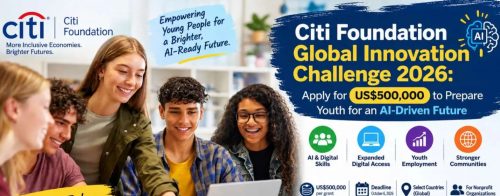
The Citi Foundation Global Innovation Challenge 2026 is now open, and for registered nonprofit organisations working on economic mobility, youth employment, and digital skills in low-income communities, this is one of the most significant grant opportunities currently available globally. The fourth edition of the challenge, titled Preparing Youth for AI, is committing a total of US$25 million to support approximately 50 community organisations, with each selected organisation receiving a restricted grant of US$500,000. The Letter of Inquiry deadline is October 6, 2026 at 12:00 p.m. New York Time.
Two things to state clearly before going further. First, this grant is exclusively for registered nonprofit organisations. Individual entrepreneurs, for-profit startups, and unregistered community groups are not eligible regardless of the quality of their work. Second, the October 6 deadline is for a Letter of Inquiry, not a full grant application. Organisations that pass the LOI stage will be notified by the end of November 2026 and invited to submit a full application in early December. Final funding decisions will be communicated no later than May 2027.
What the 2026 Challenge Is Funding
The theme of Preparing Youth for AI reflects a shift in how the Citi Foundation is framing youth economic mobility for this edition. Previous challenges focused broadly on youth employability and entrepreneurship. The 2026 challenge narrows that to one of the most consequential transitions underway in global labour markets: the displacement and restructuring of jobs by artificial intelligence, and what it takes to ensure that young people from low-income backgrounds are not left behind in that transition.
The Citi Foundation Global Innovation Challenge 2026 is looking for organisations developing practical, scalable programmes that address this challenge in one or more of the following ways:
Helping low-income youth develop AI and digital literacy skills that are applicable in real employment contexts, not just theoretical familiarity with technology.
Improving access to the physical infrastructure of digital participation, meaning devices, internet connectivity, and the supporting environment that makes digital skills training actually possible for young people who currently lack it.
Creating or expanding pathways that connect young people with concrete employment opportunities in sectors being shaped by AI, including tech, customer experience, healthcare, logistics, and other fields where AI tools are already changing what jobs look like and what skills they require.
Integrating AI tools into existing youth employability programmes to modernise their curriculum, improve their reach, or increase the quality of outcomes for participants.
Strengthening the institutional capacity of community organisations and NGOs working in this space, and building networks between them that allow best practices to travel faster.
What connects all of these is the foundation’s stated interest in combining AI and digital skills with what they call human-centred abilities: critical thinking, creativity, problem-solving, resilience, and adaptability. The argument behind that combination is one that practitioners in youth development will recognise immediately. Purely technical training without the surrounding cognitive and interpersonal skills produces graduates who can operate tools but cannot navigate the variability of real employment environments.
The Grant Amount and Disbursement
Each selected organisation receives US$500,000 as a restricted grant, disbursed in two equal annual payments. The first payment of US$250,000 is made in 2027 and the second US$250,000 in 2028, covering a 24-month grant period. The restricted nature of the grant means funds must be used for the specific programme or initiative described in the application, not for general operating purposes unless the approved proposal includes general operating costs.
For a Nigerian or African nonprofit working in youth digital skills, this two-year, half-million-dollar grant is one of the largest single awards available from a corporate philanthropy source. The Citi Foundation has invested more than US$300 million in youth employment programmes over the past decade alone, supporting over one million young people globally. The 50-organisation scale of this challenge means the selection pool is genuinely open rather than reserved for a handful of established international NGOs.
Eligible Geographies
The Citi Foundation’s target geographies are countries and communities where Citibank has an operational presence. In Africa, this includes Nigeria, Kenya, South Africa, Ghana, Egypt, and other markets where Citi maintains banking operations. Organisations operating in these countries should check the official RFP to confirm whether their specific city, region, or programme geography is within scope.
Eligible organisations in the United States are restricted to specific counties, cities, states, and territories. African and international organisations should review the geographic eligibility section of the official RFP before submitting an LOI to confirm their programme location qualifies.
Eligibility Requirements
The requirements are specific and some have the potential to disqualify organisations that do not check them carefully before applying.
Your organisation must be a registered nonprofit or the equivalent in your operating country. The legal form varies by jurisdiction but the principle is consistent: your organisation must have formal nonprofit status.
You must be able to provide externally audited financial statements covering at least part of calendar year 2024 or a subsequent year by the time the full application is submitted in early December 2026. The audited financial documentation required at the full application stage includes the auditor’s signed letter, complete financial statements, and the auditor’s notes. Organisations that cannot meet this requirement should review the eligibility rules carefully before submitting an LOI. Submitting an LOI for a programme you are ineligible for wastes both your time and the foundation’s review capacity.
Your programme must serve low-income youth and demonstrate a connection to the AI and employment-readiness theme of the 2026 challenge.
The Two-Stage Application Process
Stage 1: Letter of Inquiry (LOI)
The LOI is the first gate. The Citi Foundation uses it to assess strategic alignment, feasibility, and potential impact before committing the full review resources of a complete application to any given organisation.
One important practical note: the online LOI form cannot be saved mid-entry. If you start filling it in and close the browser, your progress is lost. The Citi Foundation specifically recommends downloading the editable PDF version of the LOI, preparing all responses offline at your own pace, and then transferring your completed answers into the online form in a single session. After submission, you cannot access your submitted LOI, so keep a copy of your final responses for your own records.
LOI Deadline: October 6, 2026 at 12:00 p.m. New York Time (Eastern Time)
Stage 2: Full Application
Organisations whose LOIs pass the initial assessment will be notified by the end of November 2026 and invited to submit a full grant application. The full application deadline is expected in early December 2026.
Final funding decisions will be communicated to all organisations no later than May 2027.
How to Apply
LOIs are submitted through the Citi Foundation’s official grant portal. The official RFP document, which contains the complete eligibility criteria, geographic scope, priority areas, and full submission requirements, is available for download from the same portal and must be read in full before you begin preparing your LOI.
Application Portal: https://www.citigroup.com/global/foundation/apply-for-funding
LOI Deadline: October 6, 2026 at 12:00 p.m. ET
The Citi Foundation Global Innovation Challenge 2026 is one of the rare corporate philanthropy programmes that combines a meaningful grant size, a globally relevant theme, and an open selection process across 50 organisations. For Nigerian and African nonprofits doing serious, documented work on youth digital skills and employment readiness in Citi-eligible countries, October 6 is the date that matters.
For more verified opportunities like this, updated monthly, visit: https://utibeetim.com/list-of-latest-opportunities-for-the-month/