
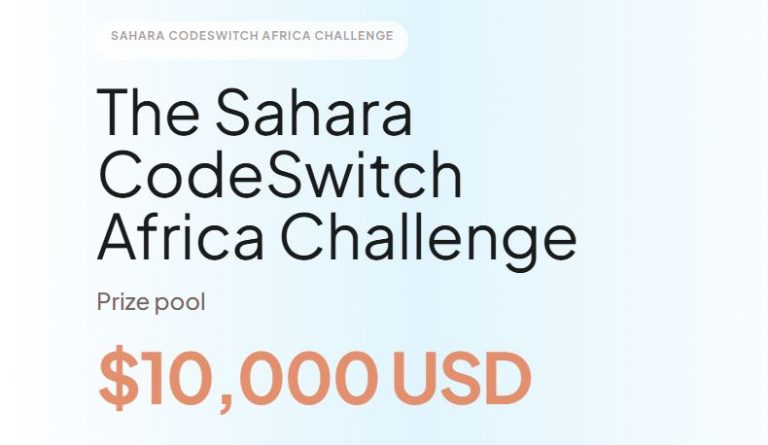
Here is a problem that most people outside AI have never thought about: voice AI systems built by global companies are largely useless for the way Africans actually communicate. A Nigerian customer service call that switches between English and Igbo mid-sentence will confuse the most sophisticated speech model on the market. A Kenyan clinic worker explaining a diagnosis by moving between Swahili and English is effectively invisible to AI transcription tools. This is not a small gap. It is a structural failure in how voice technology has been built, and the Sahara CodeSwitch Africa Challenge 2026 is putting $10,000 on the table for African builders who want to fix it.
The challenge is run by Intron, an African voice AI company, in collaboration with the MLC Africa Agentic AI Workshop. Applications are open now and close on September 15, 2026. If you are a developer, AI researcher, startup, student team, or civic-tech builder based in Africa or the diaspora, this is one of the most technically meaningful competitions open right now.
What Code-Switching Actually Means and Why It Matters
Code-switching is what happens when a speaker moves between two or more languages in the same conversation. It is not broken speech or poor language proficiency. It is the natural way that multilingual people communicate, and across Africa, it is the norm rather than the exception.
Yoruba speakers in Lagos blend their language with English constantly. Francophone West Africans move between French and local languages within a single sentence. Educated professionals across East Africa switch between Swahili and English depending on context, emotion, or the formality of the moment. This linguistic reality has been largely ignored by the companies building mainstream voice AI, because those systems were trained on monolingual audio in English, French, or Mandarin, collected in environments that look nothing like a Lagos market or a Nairobi hospital.
The result is a technology gap that has real consequences. Voice-driven healthcare tools fail in the communities that need them most. Contact centre AI misunderstands local customers. Farmer advisory systems built with speech interfaces cannot handle the way rural communities actually talk. The Sahara CodeSwitch Africa Challenge 2026 exists to surface how bad the problem is and reward the builders who start solving it.
What the Challenge Is Asking You to Build
The core task is not simply to transcribe speech. That is not the point. The challenge asks participants to build a real-world voice AI application that uses a transcript of code-switched audio to actually do something useful downstream.
The application should take a voice input and complete a task. Not transcribe and stop there, but take an action based on what was said. Examples include a voice assistant that completes a booking, a spoken-language form-filler that populates fields from what a user said, a voice-driven triage tool that routes a patient based on what they reported, or a voice interface that triggers an action in a backend system on the speaker’s behalf.
Every submission must also benchmark performance across at least three speech models: one must be Intron’s Sahara API, and the other two can be models of the team’s choice, whether global, local, open-source, commercial, pre-trained, or fine-tuned. That benchmarking requirement is intentional. The challenge wants to surface real data on how current speech models handle code-switched audio, and your submission contributes to that broader research goal.
Where possible, teams should also submit the code-switched audio samples used for testing, with basic metadata covering the language pair, domain, accent or country of origin, device type, and noise conditions. This is optional but encouraged.
The Five Competition Tracks
Every submission must be targeted at one of five verticals:
Health covers clinical documentation, patient intake, community health, maternal health, hospital workflows, and frontline care. This is the track for teams building tools that help healthcare workers capture information faster, route patients more accurately, or serve communities that have been underserved by existing health technology.
Legal and Public Services covers court transcription, legal aid, citizen services, civic reporting, complaints management, and public-sector workflows. If you are building tools that make government services more accessible through voice, or that help ordinary citizens navigate legal processes, this is your track.
Fintech, Telco, and Customer Experience covers voice banking, KYC, payments, collections, customer support, call centres, agent assist, and customer insights. Africa’s financial services sector handles enormous volumes of voice-based customer interaction every day, and most of it is poorly served by existing AI tools.
Agriculture and Education covers farmer advisory services, extension services, tutoring, classroom learning, local-language education, and skills training. This track is for teams building tools that help people learn or access agricultural knowledge through speech, in the language combinations they actually use.
Other High-Impact Use Cases is a catch-all track for humanitarian response, accessibility, media, religious services, commerce, transport, culture, and any other meaningful application of code-switching voice AI. If your idea solves a real problem but does not fit cleanly into the four tracks above, this is where you enter it.
What Winners Receive
The $10,000 total prize pool is distributed across top-performing solutions in the challenge categories. The specific breakdown per category has not been published, but the cash awards are supplemented by a set of additional benefits that compound the value of placing highly.
Top teams are invited to a virtual Partner Demo Day, where they pitch directly to judges, sponsors, and potential deployment partners. This is not a formality. The people in that room are specifically there to find solutions they can fund, pilot, or integrate into existing products.
Beyond the Demo Day, finalists receive greater visibility with Intron’s broader network of sponsors, ecosystem partners, and funders; potential pilot or deployment conversations for solutions that sponsors want to test in real environments; Sahara API credits to continue building after the competition ends; and public recognition across Intron’s channels and partner networks.
For a technical team that wants to move from competition to commercial opportunity, the combination of cash, Demo Day access, and deployment conversations is a meaningful pathway.
Who Should Apply
The Sahara CodeSwitch Africa Challenge 2026 is explicitly open to builders across Africa and the diaspora, applying as solo participants or as teams. The organisers particularly encourage:
- Software developers and engineers building applications with speech interfaces
- AI and machine learning researchers working on speech, NLP, or multilingual models
- Startups with products that involve voice or customer-facing workflows
- Student teams at African universities with strong technical capacity
- Open-source builders who want to contribute to African language technology
- NGOs and civic-tech teams building tools for underserved communities
- Companies that handle high volumes of voice-based customer interaction
There is no age restriction and no requirement to be registered as a formal business entity. Individual researchers and student teams compete alongside startups and established product companies.
How to Apply
Submissions are made through the official Intron competition platform. The application requires a working voice AI application, your benchmark results across a minimum of three speech models, and a clear articulation of the problem your solution addresses and the downstream task it completes. Optional audio sample submissions with metadata are encouraged.
Application Link: https://forms.gle/hdYcYH3jzy6iEQD68
For full technical documentation, judging criteria, and API access, visit the official challenge page at: https://www.intron.io/compete/
Deadline: September 15, 2026
That is 18 days from today. If you are a technical builder who has been waiting for a competition that is genuinely relevant to the problems African communities face, the Sahara CodeSwitch Africa Challenge 2026 is it. The deadline is close enough that starting today matters.
For more verified opportunities like this, updated monthly, visit: https://utibeetim.com/list-of-latest-opportunities-for-the-month/