
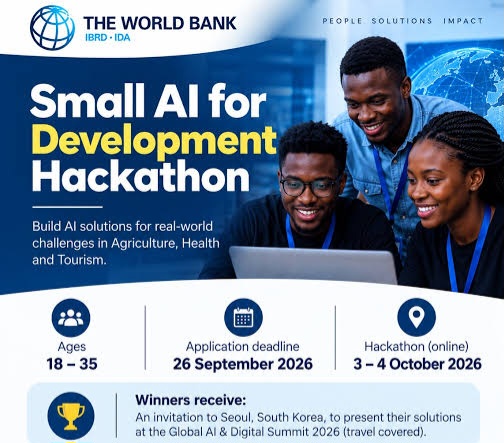
The World Bank Group Small AI for Development Hackathon 2026 is open right now for young innovators aged 18 to 35 from across the globe, and the application deadline is September 26, 2026, eight days from today. Three winners, one from each of the three competition categories, will receive a fully funded trip to Seoul, South Korea, to present their solution at the Global AI and Digital Summit 2026, co-hosted by the World Bank Group and the Government of Korea from October 19 to 22, 2026. For Nigerian and African innovators building AI solutions for real-world development constraints, this is one of the most relevant hackathons currently open anywhere in the world.
The competition is organised by the World Bank Group’s Digital and AI Vice Presidency in collaboration with the Youth Summit, the Development Economics Vice Presidency, and Information and Technology Solutions, with Hack-Nation managing the competition platform.
What Small AI Actually Means
The World Bank Group Small AI for Development Hackathon 2026 is built around a specific and honest observation: most AI being developed today assumes conditions that most of the world does not have. Reliable broadband. A smartphone. A user who already knows how to interact with AI interfaces. In environments where those conditions do not exist, which describes a significant share of the communities that stand to gain the most from AI, the tools being built globally are largely useless.
Small AI is a design philosophy that directly addresses this gap. Rather than building general-purpose AI that requires high connectivity and expensive hardware, Small AI solutions are targeted, use-case specific, and designed to function within real constraints. That means solutions that can run on basic devices, operate with limited or no internet connectivity, use local data, and work through accessible interfaces like voice, SMS, or sensors rather than assuming a connected smartphone and an AI-literate user.
As of 2025, more than two billion people globally remained offline. Over the next decade, 1.2 billion young people in the Global South will reach working age against a projected shortfall of more than 700 million new jobs. The World Bank’s argument is that AI built for the conditions of the few will not solve the problems of the many, and this hackathon is a direct invitation to the innovators who already understand those conditions from the inside to build something that works within them.
The Three Competition Categories
Every participant competes within one of three sectors. Three winners are selected in total, one from each category.
Agriculture is for solutions that improve smallholder farmer productivity, supply chain access, crop monitoring, pest management, weather-based decision-making, or any other agricultural challenge that communities in developing economies face with limited digital infrastructure.
Health is for solutions that improve access to diagnostics, patient monitoring, community health worker support, disease surveillance, medication adherence, or any other health delivery challenge in resource-limited settings.
Tourism is for solutions that improve local tourism infrastructure, destination discovery for underserved locations, cultural heritage preservation, or community-based tourism development in economies where tourism could drive significant livelihood improvement.
The connection between your solution and the sector you are competing in must be direct and clearly articulated. Judges are assessing real-world applicability, not technical sophistication in isolation.
Who Can Apply
The hackathon is open to:
Young innovators aged 18 to 35, in line with the UN definition of youth. Citizens or residents of World Bank member countries, which includes Nigeria and the vast majority of countries globally. Applicants from emerging economies are specifically and explicitly encouraged to apply. Individuals competing alone or teams of up to four members. Team members must each register individually and identify themselves as part of the same team before the registration deadline.
The following are not eligible: World Bank Group staff, consultants, or interns. Individuals competing in more than one entry. Applicants whose submissions are not in English.
For winning teams, one representative travels to Seoul to present the solution. The World Bank judging panel makes the final determination on which team member represents the group.
The Two-Step Process and Key Dates
Participating in the World Bank Group Small AI for Development Hackathon 2026 requires completing two separate steps, and failing to complete both disqualifies your entry.
Step 1: Register before September 26, 2026. Eligible applicants must complete the Hack-Nation application process through the official application form before the deadline. Registering does not by itself constitute a competition entry. It makes you eligible to participate in the actual hackathon.
Step 2: Build and submit during October 3 to 4, 2026. Registered and accepted participants develop their Small AI solution over the two-day hackathon weekend and submit it through the Hack-Nation platform within the competition window. Submissions include a video presenting the solution alongside the technical build.
After submission, entries go through expert evaluation followed by a World Bank judging panel. Winners are then invited to Seoul.
| Milestone | Date |
|---|---|
| Application deadline | September 26, 2026 |
| Hackathon competition window | October 3 to 4, 2026 |
| Global AI and Digital Summit, Seoul | October 19 to 22, 2026 |
What Winners Receive
The prize for each of the three category winners is a fully funded trip to Seoul, South Korea, to present their winning solution at the Global AI and Digital Summit 2026. Travel expenses, accommodation, and designated event-related expenses are covered in full, subject to the organisers’ internal logistics guidelines.
At the summit, winners present their solution to an audience of government leaders, investors, development finance officials, MSMEs, multilateral institutions, and global tech executives. The summit itself runs four days at the Grand Hyatt Seoul and examines how AI and digital transformation can help countries accelerate economic growth and improve public services. Being invited to present a winning solution at this event, in front of this audience, is a form of visibility and credibility that is difficult to replicate through any other route.
Winners are also featured as high-impact innovators within the summit programming.
How to Apply
Registration is completed through the official Hack-Nation platform via the World Bank Group’s Global AI and Digital Summit page. After registering, the platform provides the technical requirements, submission instructions, and the competition brief that all participants use during the October 3 to 4 hackathon weekend.
Official Application and Event Page: https://www.worldbank.org/en/events/2026/10/19/global-ai-and-digital-summit-2026
Registration Deadline: September 26, 2026
General Enquiries: [email protected]. The organisers have stated that due to anticipated application volume, they cannot respond individually to questions about eligibility, application status, or judging results. Read the official documentation carefully before applying.
The World Bank Group Small AI for Development Hackathon 2026 is built specifically for the kind of innovator who understands that the hardest AI problems are not about building more powerful models. They are about building the right models for the conditions that actually exist in the communities that need them most. If that is the problem you have been thinking about, you have eight days to register.
For more verified opportunities like this, updated monthly, visit: https://utibeetim.com/list-of-latest-opportunities-for-the-month/