
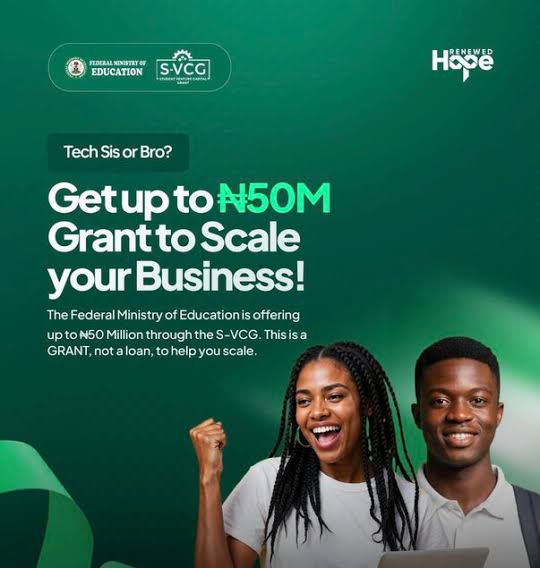
The Student Venture Capital Grant 2026 is one of the largest government-funded student enterprise programmes Nigeria has ever run, and the application window closes on September 30, 2026. Administered by the Federal Ministry of Education through its Special Programme Operations and Implementation Unit, this is the second cohort of the programme, also known as the Next Moonshot Initiative. It will select 50 outstanding student-led ventures from across Nigeria and offer each one up to ₦50 million in equity-free funding to develop and scale their businesses. No equity is taken. No ownership is surrendered. The total funding pool across all 50 selected ventures amounts to ₦2.5 billion.
If you are a Nigerian student currently enrolled in a university, polytechnic, or college of education, leading a STEMM-based business that has moved beyond the idea stage, and your venture is registered with the Corporate Affairs Commission, the Student Venture Capital Grant 2026 is the most significant opportunity available to you between now and the end of September.
What the Grant Is and How the Funding Works
Before going further, one important distinction is worth stating clearly. The ₦50 million is a ceiling, not a flat cheque. Funding is disbursed in tranches against milestones that the selected venture agrees on with the programme team before disbursement begins. This means successful applicants draw down against their grant as they hit defined targets rather than receiving the entire amount upfront. That structure is standard for serious grant programmes and is designed to ensure funds are deployed against real business progress rather than consumed without measurable output.
The programme is also explicit that slide decks and business plans alone will not clear the bar. Your venture must have a working proof-of-concept, a prototype, or a product that already functions in practice. An idea at its earliest stage, however compelling, is not the target profile for this cohort.
Alongside the funding, selected ventures receive business validation support, business model guidance, bootcamp training, and six months of structured mentorship. Ventures that are not selected for funding still receive feedback on their applications, which is worth factoring in when deciding whether to apply.
Selected ventures are also listed in the S-VCG Innovation Repository, a database maintained by the Ministry that keeps submitted projects visible to investors, academic institutions, and potential partners beyond the grant period itself.
Who the Programme Is For
The Student Venture Capital Grant 2026 has a specific applicant profile. Every element of the eligibility criteria matters:
You must be currently enrolled in a Nigerian university, polytechnic, or college of education. Distance learning and part-time enrolment have not been confirmed as qualifying.
You must be at or above 300 level or the equivalent academic stage in your institution. The programme targets students who are deep enough into their academic journey to have both the knowledge and the time investment in their field that meaningful venture-building requires.
Your venture must be in a STEMM field. The programme covers science and biotechnology, agriculture and agri-tech, software and hardware, artificial intelligence, engineering and industrial solutions, mathematics and data science, financial modelling and fintech, and health and medical technology. These categories are deliberately broad, which means a student building an agricultural monitoring system, a healthcare diagnostic tool, a data analytics platform, or an AI-powered service all qualify.
Your venture must have moved beyond proof-of-concept. The programme is not for ideas that exist only on paper. Something must have been built, tested, or deployed, even at a small scale, for your application to be competitive.
Your business must be registered with the Corporate Affairs Commission. An informal, unregistered business does not meet the eligibility criteria. If your venture is not yet registered, that is the first thing to address before submitting an application.
You must be the founder or lead of the venture, not a member of another founder’s team applying under their initiative.
The Nationwide Roadshow
To maximise access and awareness across Nigeria’s six geopolitical zones, the Student Venture team and its partners are conducting a nationwide application roadshow from September 6 to September 30, 2026. The roadshow is visiting nine tertiary institutions: the University of Abuja, Nile University, Abubakar Tafawa Balewa University, Bayero University Kano, Kano University of Science and Technology, Federal Polytechnic Kaduna, Ambrose Alli University, the University of Lagos, and Covenant University.
In addition to the roadshow stops, a Campus Ambassador Programme is running across 20 additional tertiary institutions to extend awareness to institutions not on the main tour. If your campus is among those 20, the Campus Ambassador is a useful resource for application guidance and information sessions before the deadline.
Even if no roadshow event is visiting your institution, the application portal is open and accessible to students anywhere in Nigeria.
What a Strong Application Looks Like
The Ministry has been clear about what it is looking for. A competitive Student Venture Capital Grant 2026 application will demonstrate a real, operational business in a STEMM field with documented traction, a clear problem-solution fit, evidence of what has been built or deployed so far, CAC registration confirming legal existence, and a business plan that includes specific expenditure milestones and KPIs against which the grant tranches can be measured.
That last point matters more than most applicants realise. The grant is disbursed against milestones. If your business plan does not contain specific, measurable milestones and key performance indicators, the programme has no basis for structuring your disbursement schedule, and your application is weaker for it. Quantify your targets, connect your funding request to specific activities, and make the path from grant receipt to milestone completion explicit.
Applications that consist primarily of a pitch deck, a vision statement, and general language about the problem being solved will not compete with applications that show what has already been built, who is already using it, and exactly what the ₦50 million will produce.
How to Apply
Applications are submitted through the official Student Venture Capital Grant portal.
Application Portal: svcg.education.gov.ng
Deadline: September 30, 2026
That is 16 days from today. Given that the roadshow ends on the same date as the application deadline, there is no extension expected. Submit early rather than assembling your application in the final days when portal traffic is likely to be highest.
The Student Venture Capital Grant 2026 is the Federal Government’s clearest signal that it is willing to back student entrepreneurs at meaningful scale, without demanding equity, provided those entrepreneurs can show they are building something real. If you qualify and your venture meets the criteria, September 30 is the most important deadline on your calendar this month.
For more verified opportunities like this, updated monthly, visit: https://utibeetim.com/list-of-latest-opportunities-for-the-month/